
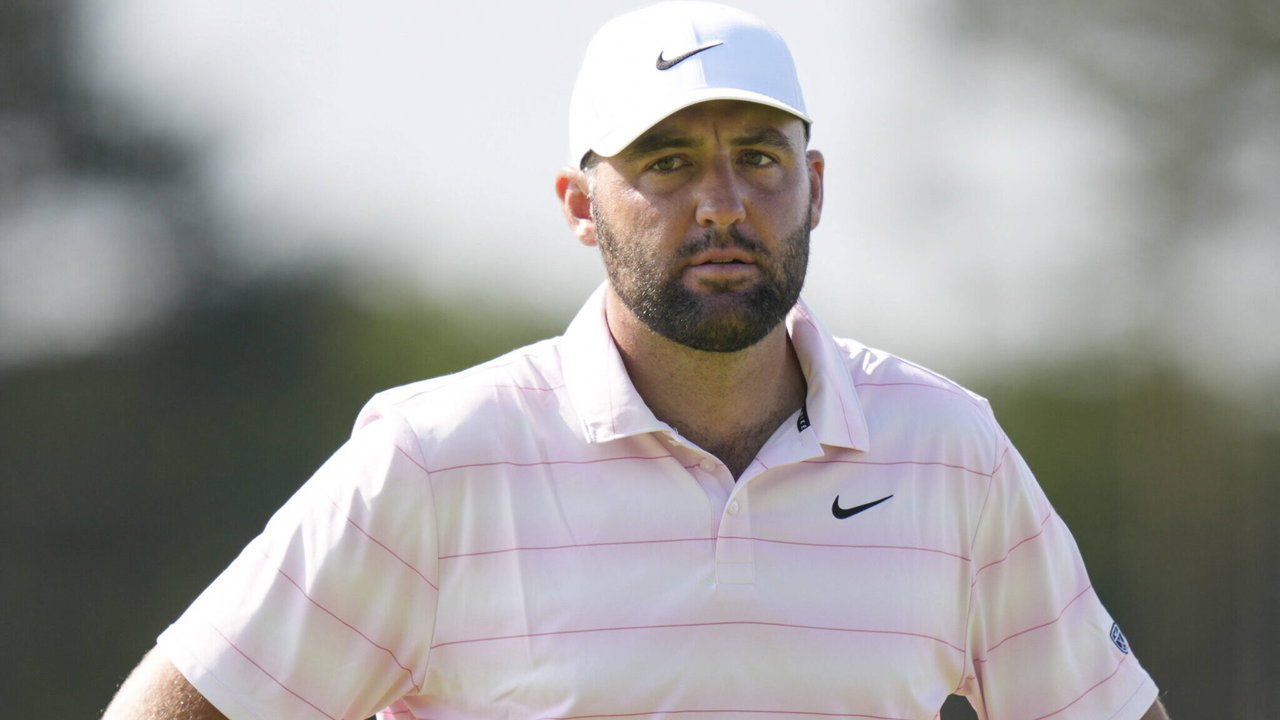
Scottie Scheffler had just helped Team USA win its first point at the 2026 Presidents Cup, but Paul McGinley still felt Scheffler had more to prove. Speaking on Golf Channel after Thursday’s four-ball session, the two-time Ryder Cup winner didn’t hold back.
Watch What’s Trending Now!
“Best player in the world, but not the best team player,” McGinley said. “I’m not intimidated playing Scottie in match play compared to what I am in 72-hole events. There’s two different players there. He hasn’t proved himself yet in team events. He hasn’t.”
To be clear, McGinley was not saying Scheffler is a poor golfer or that he cannot handle team events. His point was much more interesting than that. Scheffler can dominate a 72-hole tournament, but match play is a completely different test. There is no time to recover from a bad hole, and every mistake feels bigger. That is where McGinley believes Scheffler still has something to prove.
“By far the best player in the world,” McGinley called him before drawing the distinction. In stroke play, across four rounds, Scheffler is close to unbeatable. In an 18-hole match against one player, McGinley argued that intimidation factor simply isn’t there in the same way.
This is not really about saying Scheffler struggles in team events. The bigger question is what happens when a 72-hole tournament becomes just 18 holes. Scheffler is dominant on his own, but team events leave very little room for mistakes.
Scottie Scheffler and Sam Burns had just beaten Min Woo Lee and Sungjae Im 1-up in the opening four-ball match. It was the only match that went all the way to the 18th hole, helping Team USA take a 3-2 lead after the first session. But it was far from easy. Lee and Im went 1-up after 13 holes before Burns quickly answered with a birdie on 14. The Americans then won the 17th and 18th to close it out. Scheffler delivered the final blow, hitting his approach on 18 to just six inches and sealing the point.
McGinley made sure to give credit where it was due, and it wasn’t primarily to Scheffler. “Sam Burns played really well,” McGinley said. “I thought he buoyed Scottie. He buoyed Scheffler.” It’s a pointed contrast: even in a match Scheffler and Burns won, McGinley’s read was that Burns did more of the heavy lifting than Scheffler.
McGinley did not stop there. He also brought up Tiger Woods as an interesting comparison. Woods is one of the greatest golfers ever, but his Ryder Cup record was not always as strong as his individual record. That shows how different team events can be, even for the biggest stars.
Still, McGinley was not ready to judge Scheffler yet. He believes Scheffler has plenty of team events ahead of him, and his record could look very different in the future. So, writing him off now would be too early.
McGinley also had another theory. He suggested that some players might feel extra pressure when they play alongside Scheffler. Having a superstar next to you could make you play more carefully or nervously. But Burns showed no signs of that on Thursday. He looked comfortable next to Scheffler and played a big role in their win.
The Presidents Cup adds another layer to this debate because it is very different from a normal stroke-play tournament. Players do not get four rounds to recover from a bad hole or build their score.
It is a team event. Players compete in four-ball and foursomes matches for the first three days. On Sunday, they play 12 singles matches. Each match gives one point, and a team needs 15.5 points to win. The U.S. has done very well in this event. Before the 2026 event, the U.S. had won 13 of the 15 Presidents Cups and the last 10 in a row.
So there is plenty of pressure on American players to perform. Match play can also change quickly. Losing one hole can put a player behind, while winning the next can bring him right back into the match. Players can even concede putts or holes, which you do not see in normal stroke play.
That makes Scheffler’s record interesting. Before this year’s event, he was 3-5-1 overall in the Presidents Cup, including 0-2 in singles and 2-0-1 in four-ball. He then teamed up with Sam Burns on Thursday and beat Min Woo Lee and Sungjae Im 1-up, moving his record to 4-5-1.
Team USA’s captain, Brandt Snedeker, kept faith in the pairing and sent Scheffler and Burns out again on Friday, this time in foursomes, the alternate-shot format that has historically been the Americans’ strongest suit but has bitten them in recent editions. Their opponents were an all-Canadian pairing, Corey Conners and Nick Taylor, with Taylor making his Presidents Cup debut after sitting out Thursday.
Scheffler picked up right where he left off, sticking an approach to three feet at the second hole to help the Americans move 1-up, and they were still 1-up through four. For a moment, it looked like exactly the kind of dominant version of Scheffler that shows up every week on the PGA Tour. It didn’t last. Conners rolled in a birdie to square the match, and Conners and Taylor eventually closed it out 1-up, handing Scheffler and Burns their point right back.
It was one of five results to come in for International on Friday, as the team swept the entire foursomes session. Sungjae Im and Hideki Matsuyama beat Russell Henley and Jacob Bridgeman 3&2, Ryan Fox and Min Woo Lee beat Wyndham Clark and Collin Morikawa 1 up, Adam Scott and Christiaan Bezuidenhout beat Justin Thomas and Cameron Young 3&2, and Tom Kim and Si Woo Kim beat Patrick Cantlay and Xander Schauffele 4&3. The clean sweep pushed International’s lead to 7-3 heading into Saturday.
That loss speaks directly to the McGinley debate. Scheffler again looked every bit the best player in the world in flashes; the approach at the second was proof of that. But the match slipped away rather than being closed out. For a stretch of holes, it didn’t look like the world No. 1 golfer he is. And Scheffler’s own overall Presidents Cup record slid back to 4-6-1. It is almost the exact pattern McGinley described: brilliant stretches from Scheffler individually, but not yet the kind of stranglehold on a match that he applies week to week in stroke play.
McGinley may be asking everyone to wait 15 years before judging Scheffler’s team-event record, but that feels like a very long wait when the next test is already here. Scheffler does not need another decade to show what he can do. Every team session gives him another chance to change the conversation, and Friday’s foursomes did little to settle the argument either way.
Foursomes puts even more pressure on every shot because partners take alternate shots. One poor swing can put the other player in a difficult spot, and Friday’s session was a reminder of just how quickly that format can turn on a team that was cruising a few holes earlier. Saturday brings a rare double session, morning four-ball followed by afternoon foursomes, before Sunday’s 12 singles matches decide the Cup. For now, Scheffler’s team-event story is far from finished. If anything, after a mixed follow-up to Thursday’s win, the debate McGinley raised looks more relevant than ever.