
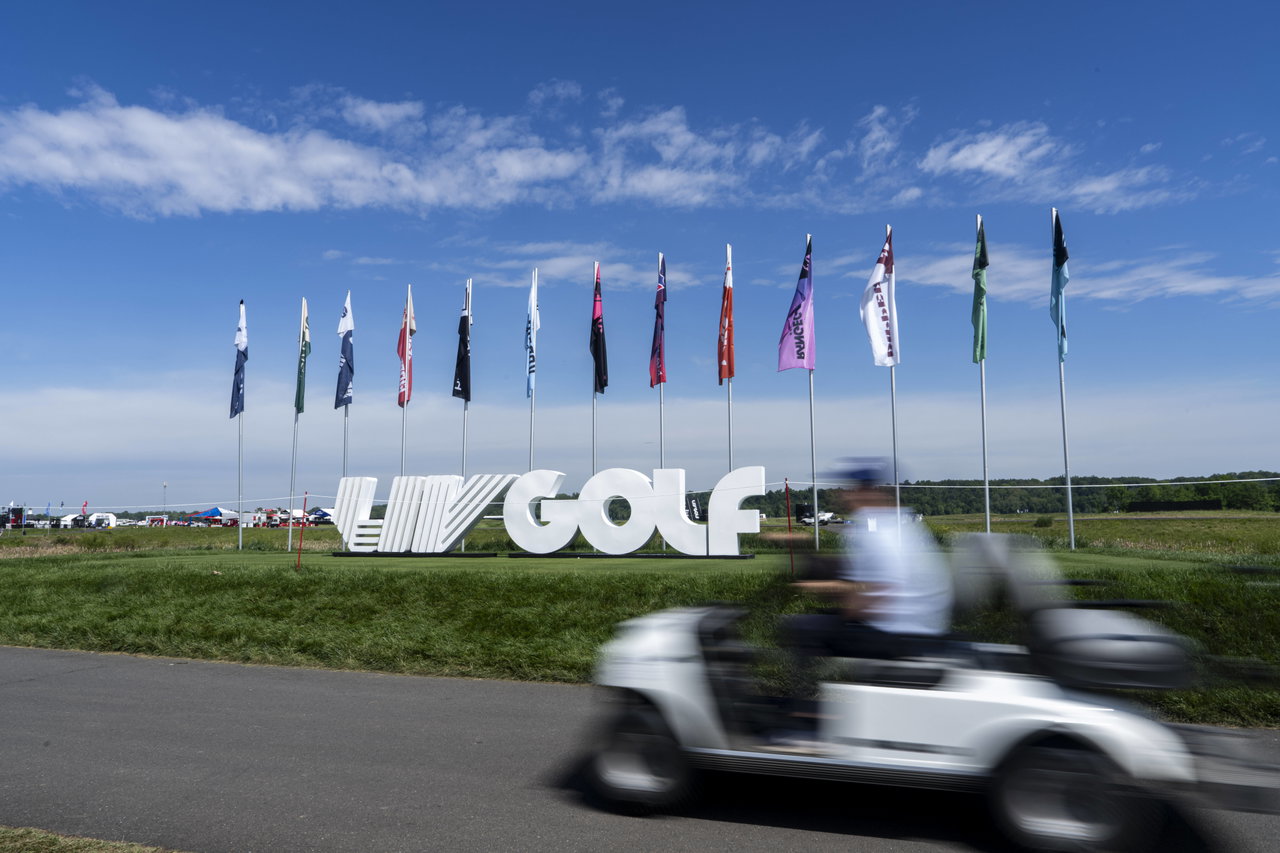
LIV Golf’s bankruptcy has put its future schedule and player contracts under scrutiny, but its early financial disclosures have raised another question: How accurate is its picture of what the league owes? The circuit closed its 2026 season in August and filed for Chapter 11 protection in New Jersey on September 8 after the Saudi Public Investment Fund, which spent more than $5 billion on LIV following its 2022 launch, stopped funding it.
Watch What’s Trending Now!
One creditor on LIV’s list of largest creditors says it should not be there. GSE Worldwide, the agency that represents Bryson DeChambeau, told Front Office Sports that LIV does not owe it any money. LIV’s opening filing tells a different story, naming GSE among the league’s 30 largest unsecured creditors with a balance of $1,287,500.
A denial like that raises a fair question about how firm the numbers are. LIV reported liabilities between $500 million and $1 billion against assets of $100 million to $500 million.
One entry on the creditor schedule is already in dispute. GSE Worldwide, the agency that represents Bryson DeChambeau, told Front Office Sports that LIV does not owe it money, despite LIV listing GSE as its 19th-largest unsecured creditor with a $1,287,500 claim.
The discrepancy does not mean the full schedule is wrong, but it raises a fair question about how firm the numbers are. LIV reported liabilities between $500 million and $1 billion against assets of $100 million to $500 million, and bankruptcy schedules are debtor-prepared, early-stage disclosures that can include claims later disputed, revised or removed.
The filing lists Jon Rahm at about $7.5 million and DeChambeau at about $5.8 million. USA Today counted 27 names owed a combined $64.2 million. Dustin Johnson, listed at roughly $5.5 million, has a claim the filing flags as contingent, unliquidated and disputed. ESPN noted that the listed totals reflect past-due payments, not what players could still be owed beyond the filing date.
ESPN noted that the totals reflect past-due payments, not what players could still be owed beyond the filing date.
The October 7 hearing in Trenton is the second in the case, and it will take up LIV’s motion on its executory contracts and unexpired leases.
Executory contracts are agreements in which both sides still owe something, and the motion covers player deals such as Rahm’s. If LIV assumes a contract, it keeps honoring it. If it rejects one, the contract is treated as breached and the player joins the line of creditors. Those contracts reportedly make up a large part of the estimated liabilities.
Bryson DeChambeau’s decision carries outsized weight in that process. His LIV contract expired after the 2026 season, leaving him free to decide whether to join the proposed LIV 2.0 structure. He is not only one of the league’s largest listed player creditors, at roughly $5.8 million, but also one of its most recognizable active stars, alongside Jon Rahm, Cameron Smith and Dustin Johnson.
LIV does not specifically need DeChambeau to satisfy BC Partners’ player-support condition. The restructuring agreement requires backing from a set share of players with claims and a set share of the total value of those claims. Still, losing DeChambeau would weaken LIV’s commercial case. BC is backing a model built around retaining established players, shifting some compensation toward equity and team ownership, and relaunching LIV as a viable 2027 product.
His departure would also test confidence in the restructuring. LIV wants to reject its existing player contracts while negotiating replacement long-term agreements for LIV 2.0. If DeChambeau declines a new deal, LIV would lose both a marquee competitor and a major selling point as it tries to convince investors, broadcasters, sponsors, tournament hosts and other players that its post-bankruptcy model can work.
The league entered bankruptcy with $15 million on hand, and at the first hearing on September 9, Judge Michael Kaplan approved access to an initial $14 million of a PIF loan worth close to $50 million.
Fresh money depends on BC Partners, the private equity and credit firm prepared to put $300 million into LIV after it leaves bankruptcy. The Financial Times reported that BC is weighing a separate $10 million loan to help fund the process while the PIF raises concerns about the proposed deal.
BC has also set an October 13 deadline for enough players to sign new contracts, or it could walk away from the $300 million. The restructuring agreement sets the bar at half of the players with claims, holding two-thirds of the total player claim value. LIV has reportedly secured more than enough verbal commitments to clear that line.
One bankruptcy attorney doubts the league gets there. “I think there’s a significant risk that it doesn’t come out of Chapter 11,” said John J. Sparacino, a Houston-based attorney and principal at McKool Smith. That outcome would mean LIV shuts down and winds up its operations entirely. One route is conversion to Chapter 7, where a trustee sells off assets to pay creditors.
The seven-member unsecured creditors committee, appointed September 30, meets October 15. It is charged with investigating LIV’s operations and helping shape a reorganization plan, and Michael La Sasso, who won the league’s final event in Indianapolis, is its lone player member.
The committee represents unsecured creditors, and Sparacino cautioned that, because LIV has so little cash, any of their claims are “worthless.”
The fallout is already reaching events. Kooyonga Golf Club in Adelaide filed a motion asking the court to force a decision by November 6 on LIV’s March 18 to 21, 2027 stop. The club says another month of preparation could cost about $70,000, and it claims about $134,000 in out-of-pocket expenses for October through December.
Kooyonga asked for a ruling on October 7 and LIV asked the judge to wait until November 5. Kaplan set October 22. LIV has not released a 2027 schedule and is not expected to do so until the case concludes.
The calendar leaves little room. If too few players sign by October 13 and BC walks away, the league could fail to emerge from Chapter 11, the outcome Sparacino warned about. Hearings are also set for October 22, when the judge is due to take up Kooyonga’s motion, and November 5.
The reported verbal commitments could ease that risk, but they are not signed deals. Until GSE’s denial is squared with the filing and the other claims are tested, the true size of LIV’s debt will stay hard to pin down.