

Scottie Scheffler has one of the most unorthodox swings on the tour. His footwork alone looks like he would topple over any moment, yet it has produced some of the most consistent ball-striking in the world. The world number one has had six top-three finishes since January but has yet to convert them into a win. With the US Open at Shinnecock Hills now just days away, a former PGA Tour winner, who studied Scheffler closely on the range, shares that he has spotted a subtle issue with his swing.
Watch What’s Trending Now!
“I see a potential sequencing and timing issue that I haven’t seen out of his body and arm swing,” Arron Oberholser shared on The Smylie Show. “I think I see certain things when I really study him on the range. It seems like sometimes he might be trying to do this, but sometimes he’ll stay; he’ll maintain the width of his swing really well. And he’ll stay wide, and he’ll maintain that angle all the way through the golf swing. And that seems to me to be when he hits his best shots.
“When he was on the range a couple of times, it was really weird. He had a different, almost like a downturn from the top, and he got narrower, or he would get narrower, it seemed to me. Like, he didn’t maintain the width. And that’s when he would either get an overdraw, or usually it would be a push, kind of a push out to the right, and then it would leak off that. You could tell he was a little visibly frustrated.”
Understanding Scheffler’s swing becomes important here. His swing is built around ground reaction forces. His back foot shifts towards the ball during the backswing and then pushes away during the downswing, generating the horizontal force that drives his rotational speed.
Teacher Colin McCarthy has spoken about his swing, and as she puts it, plainly, the feet moving is “a reaction to something that has already happened.” “Scheffler calls it a ‘body release.”
Over the years, his swing has changed, too. Scheffler’s coach, Randy Smith, has been with Scheffler since he was seven years old, and he has never tried to change his footwork. He has explained that Scheffler has experimented with a quieter base, and the ball has always gone shorter and lower. Over the years, as Scheffler grew to 6’3″, his footwork became more and more pronounced. The bigger and stronger he got, the more his foot moved with the swing.
This swing can be credited to one of the most dominant stretches he has produced on the PGA Tour. He has won seven tournaments in 19 starts in 2024, as he made the cut in every start and finished top 10 in 16 of them. The four-time Major champion has also produced a wonderful performance on the Memorial back-to-back in 2024 and 2025.
Furthermore, in an interview with Golf Digest in 2022, Scheffler candidly talked about what happens when his swings break down. He even speaks about a consistent issue that causes it.
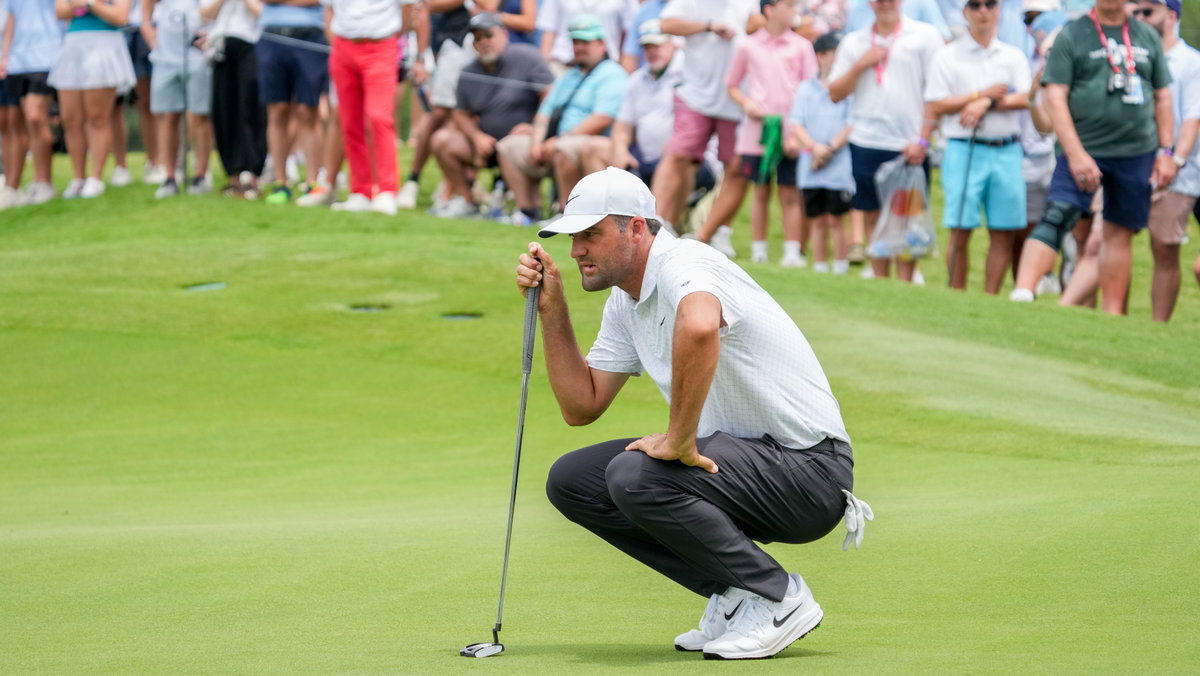
Imago
May 23, 2026; McKinney, Texas, USA; Scottie Scheffler lines up a putt on the fourth green during the third round of THE CJ CUP Byron Nelson golf tournament. Mandatory Credit: Raymond Carlin III-Imagn Images
“I sometimes set my hips with a bump away from the target, and that causes me to slide back and squat down instead of making a good turn,” he said. “When you turn instead of sliding, you can get your hands deeper and farther away from the center of your chest, and you have more room and time to swing down with speed.”
The correct position for him, as he explained, is when his hips stack over his knees in a slight tilt in the belt and shoulders. When that setup drifts, the club crosses the line on top as his spine gets too upright, and he loses track of where the club head is.
“When my swing gets off, it’s usually something that’s very basic about what I’m doing,” Scheffler said.
Analysts who have studied this swing closely note that Scheffler’s huge lateral hip shift on the downswing works as a counterbalance to make his system work. Without it, the upright backswing and wide arc would produce a severe slice. His hip slide and the width are paired, and one cannot function without the other. And that adds up to an Arron Oberholser. observation about narrowing the top being significant.
His performance at the 2025 U.S. Open at Oakmont was a clear example of what happens when his swing doesn’t work along with him. Scheffler had arrived at the tournament with what he described as his swing in a good place, but it did not stay there. The left miss off the tee bothered him across three days. He had shot 73 in round one and ground out a 71 on Friday.
He was seen visibly frustrated in the rain session with Smith afterwards. He even admitted the session had ended without a resolution. With the tournament winner finishing at 1-under par, a 4-over par finish for Scottie Scheffler means he was mathematically exactly five shots back from the lead.
Now, just days away from the U.S. Open, Shinnecock can set up as a double-edged proposition for Scheffler. He visited the course ahead of the Memorial and said he was surprised by the width of the fairways, adding that the green complexes are going to be extremely difficult. If he and his swing can go through it, the challenge remains to be seen.