
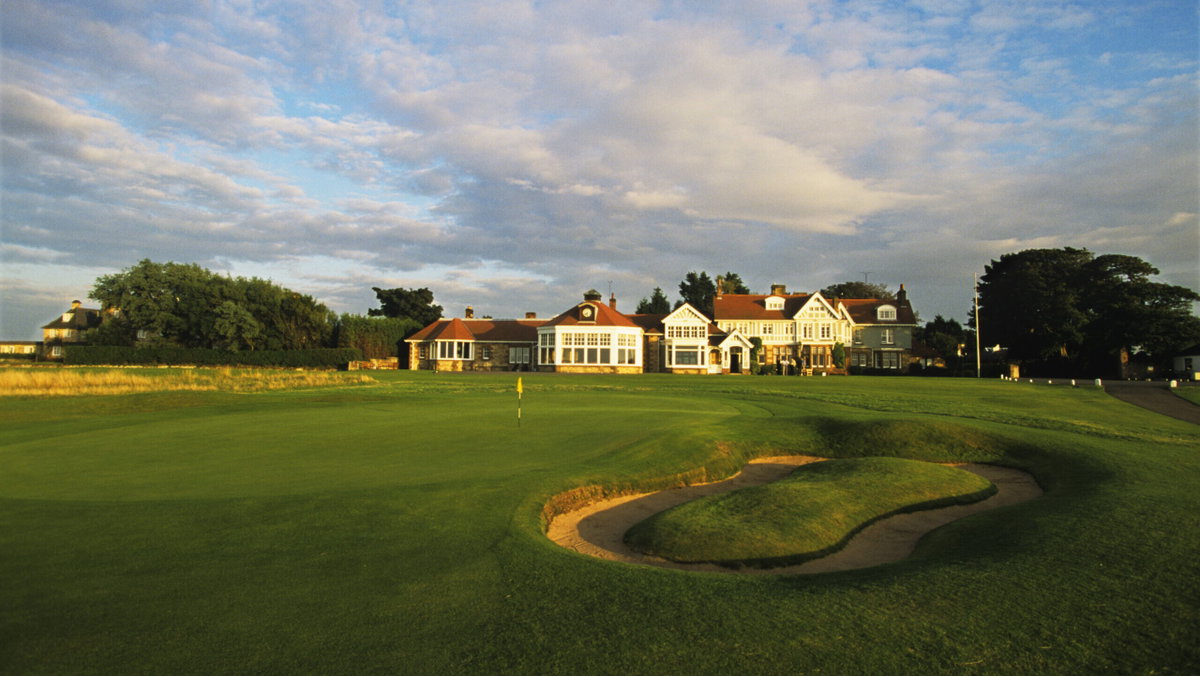
What was once a century-old clubhouse is now a marvel of modern-day architecture. Where iconic trophies decked the cabinet, now stand newly minted replicas. The Oakland Hills Country Club, which saw Ben Hogan lift the 1951 U.S. Open trophy, was ravaged by an all-engulfing fire four years back. The historic club opened after four years with a new clubhouse that bears striking similarities to the old one.
Watch What’s Trending Now!
That–rescuing, preserving, and then returning whatever the fire left as a residue–matters because Oakland Hills has never simply been another tournament venue. The club has hosted six U.S. Opens and is already scheduled to host its seventh in 2034. It has also staged three PGA Championships and the 2004 Ryder Cup, placing it firmly among the small group of American courses that have shaped the championship calendar across multiple eras.
Marc Ray, Oakland Hills general manager, summed it up pithily: “Today what stands behind me is new, but what it represents is timeless, not just a rebuild, but re-imagined with intention, generations that came before us.”
That history was part of the reason the United States Golf Association moved quickly after the 2022 incident, which destroyed the clubhouse. With no permanent clubhouse standing, the USGA still awarded Oakland Hills future major championships, including the U.S. Women’s Open in 2031 and 2042 and the U.S. Open in 2034 and 2051. At the time, USGA chief championships officer John Bodenhamer summed up the confidence behind that decision simply: “From ashes will come triumph.”
And triumph it is. Inside the new clubhouse, it has also found ways to reconnect visitors with its championship past. Glass-enclosed display cases now feature photographs, clubs, shoes, and other memorabilia linked to players like Jack Nicklaus, Arnold Palmer, and Andy North, who won his second U.S. Open at Oakland Hills in 1985. About 10 important artifacts were lost in the fire, but former champions, including Nicklaus, helped rebuild the collection through donations and auction recoveries.
The construction timeline itself moved steadily once plans were finalized. Ground was broken in December 2023, major construction began in July 2024, and the project stayed on schedule even as costs climbed from an early estimate of roughly $80 million to about $104 million. Insurance proceeds covered part of that increase, with the remainder supported through dues approved by the club’s more than 500 full stockholding members.
View this post on Instagram
Much of the architectural approach focused on restoring what members already knew while quietly improving how the building functions. The design follows the spirit of Detroit architect Howard C. Crane’s original 1921 plans, but spaces were reshaped to better support both daily use and championship-scale events.
The ballroom was moved to the second floor, the history corridors were widened to display trophies and archival material, and the flow between dining, lounge, and bar areas was redesigned to feel more connected than before.
Even while the permanent clubhouse was gone, Oakland Hills never stepped away from championship golf. The club hosted the 2024 U.S. Junior Amateur using a temporary tented structure near the first tee. The 264-player field included Charlie Woods, with his father, Tiger Woods, in attendance, and champion Trevor Gutschewski’s commemorative shadow box now sits just off the main foyer inside the new building.
For many around the club, that stretch without a clubhouse reinforced what the building had always meant in the first place. As general manager, Marc Ray said earlier in the rebuilding process, “We didn’t just lose a building; we lost a familiar setting for life’s milestones. But what we did not lose, and what could never be taken, was the spirit of this club.”
Now, with the clubhouse restored on its original footprint and shaped to resemble the structure that stood there for more than a century, Oakland Hills has something that feels both familiar and forward-looking at the same time: a place ready again to host the next chapter of championship golf where so many of the previous ones were written.
Inside Oakland Hills’ new clubhouse: What has changed and what has not
The rebuild followed Howard C. Crane’s original 1921 blueprints, so the building feels familiar the moment you walk in. Marble, mahogany, brass, traditional green wallpaper, and the 10 white wooden pillars that soar more than 30 feet over the veranda are all back where they belong.
However, some things have changed or grown. The grand ballroom was moved from the first to the second floor. The women’s locker room has been enlarged, the men’s locker room now takes up two floors, and four new second-floor balconies give sweeping views of the course, which is ranked No. 20 in the United States by Golf Digest.
The pro shop got a full rework, too. Alongside a tweaked Oakland Hills logo, new merchandise features a green dragon, referencing the 1951 U.S. Open cartoon where Ben Hogan famously said he brought “this Monster to its knees.” This year marks the 75th anniversary of that championship, making the nod particularly well timed.
Beyond the main clubhouse, the rebuild added a new maintenance facility, a lifestyles building, expanded caddie and administrative space, additional kitchens, lounges, and a cigar room. With seven USGA championships scheduled between 2029 and 2051, every addition was built with that future in mind.