
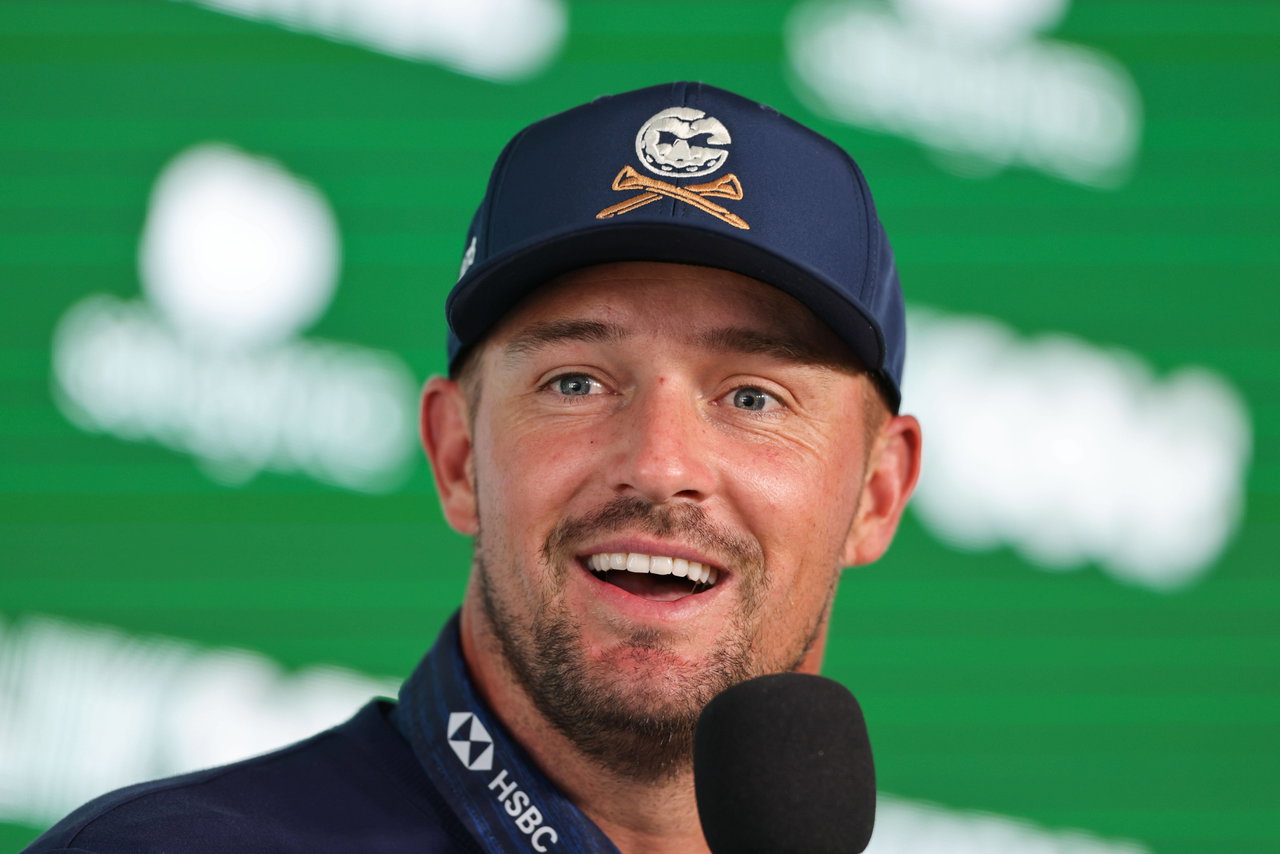
Bryson DeChambeau has become one of LIV Golf’s most prominent defenders as the breakaway league attempts to secure its future for 2027. However, with several established names walking away and questions mounting over the proposed LIV 2.0 structure, not everyone understands why the two-time U.S. Open champion wants to take on the challenge of rebuilding the circuit.
Watch What’s Trending Now!
That question became a major talking point on the latest episode of the No Laying Up Podcast. Hosts Soly and Neil discussed Bryson DeChambeau’s recent interview with Indian podcaster Raj Shamani. During the interview, the American professional expressed confidence in LIV’s proposed business model.
“But I guess my thing with Bryson is like, he says it in that interview. It’s going to be real golf. It’s not going to be any funny business. Like, dude, you got a great funny business going on YouTube. I don’t know why. Why isn’t Bryson playing in the Internet Invitational straight up? I almost feel like the play for him is just beast mode, the view counts on YouTube, and play the majors for a little while,” Soly said on the podcast.
He then went on to suggest why he should focus on his YouTube channel rather than LIV 2.0
“Look around, man, the BC guys just want the tax write-off; the vultures are circling. What are you doing sticking around? I just don’t get that. I think go do your YouTube thing; it’s working. The funny golf is working. You’re part of this multi-channel network the Blitzers got going with the YouTube ads. There’s money to be made right there.”
Neil then pointed out that Bryson DeChambeau’s YouTube appeal partly comes from his identity as an active professional golfer. Watching a major champion take part in entertaining challenges carries a different appeal than watching someone who has abandoned competitive golf to become a full-time content creator.
Continuing to play in the majors, therefore, would be central to the proposed alternative.
He has already won two major championships, both US Opens in 2020 and 2024.
The suggestion also reflects the commercial opportunities available through the growing YouTube golf ecosystem. His YouTube channel has over 3 million subscribers. Across 327 videos, he has garnered over 741 million views. In fact, before renewing his contract with LIV Golf, he said he would be okay becoming a full-time YouTube golfer if the contract does not renew and the PGA Tour does not allow him back.
Bryson DeChambeau has also built a recognizable digital presence and is part of the wider creator network around the Blitzers. His recent Bryson’s Backyard Games, a $100,000 winner-take-all golf competition filmed at his property, also demonstrated his ability to create entertainment beyond traditional tournament coverage.
The timing of the discussion is particularly significant. LIV Golf is preparing for a major restructuring after Saudi Arabia’s Public Investment Fund decided to withdraw its financial support following the 2026 season.
The proposed restructuring received a significant financial boost when BC Partners Credit announced plans for up to $300 million in financing.
However, securing financial backing has not resolved the league’s biggest immediate problem. LIV Golf has failed to retain enough established players to make the competition attractive.
The departures have included several recognizable names. Jon Rahm, Tyrrell Hatton, Sergio Garcia, Ian Poulter, Graeme McDowell, Louis Oosthuizen, Lucas Herbert, Charles Howell III, David Puig, Adrian Meronk, Thomas Pieters, Abraham Ancer, Branden Grace, and Tom McKibbin are among the players who have announced they will not return for the proposed 2027 season.
There is some interest, though, in the proposed revival. Reports indicated that approximately 15 to 20 professionals were tentatively committed to LIV 2.0. Only a handful of players had publicly expressed their intention to remain, including Richard Bland, Cameron Tringale, Brendan Steele, Ben Campbell, and Victor Perez.
This uncertainty explains the competitive concern raised on the podcast.
While the podcast’s criticism largely focused on DeChambeau’s decision to stay involved, his comments to Raj Shamani offer a clearer picture of why he remains interested in the project.
Speaking on the Figuring Out podcast, Bryson DeChambeau acknowledged that LIV’s original management structure had significant shortcomings.
“And the top company just wasn’t really managed that effectively. And I know that now… I didn’t know that during the time,” he said.
He also explained that the proposed business model would give players greater control over the league’s future, even if that meant accepting less money upfront.
“We’re not really getting paid, but we do have the governance, you know, control,” Bryson DeChambeau explained.
DeChambeau also defended LIV’s position within professional golf, saying, “It’s not combative. We’re not trying to compete against the [PGA Tour]. We want to be accretive. We want to bring value to anywhere and everywhere in the golf market across the world.”
His use of the word “accretive” became particularly relevant to the No Laying Up discussion.
One speaker summarized that skepticism with the remark, “You’re not fooling me with the jargon.”
The No Laying Up discussion also revisited an earlier DeChambeau interview that has remained associated with his public defense of LIV Golf.
In August 2022, shortly after joining the breakaway circuit, DeChambeau appeared on Tucker Carlson Tonight and compared the PGA Tour-LIV dispute to two competing pizza shops.
He argued that the original business should not be able to ban customers simply because they chose to visit its competitor.
He concluded the analogy with the question: “What’s wrong with that economic model?”
However, Bryson DeChambeau’s argument deserves consideration beyond the terminology. Greater player ownership could give LIV participants a meaningful role in decisions that previously rested with its financial backers. Whether that arrangement can sustain the business is a separate question.
He appears genuinely interested in the team-based format and believes a player-owned structure could address the management problems.
Bryson DeChambeau has already shown that he can attract an audience on YouTube. Now, he needs to do the same for LIV Golf, but could he?