
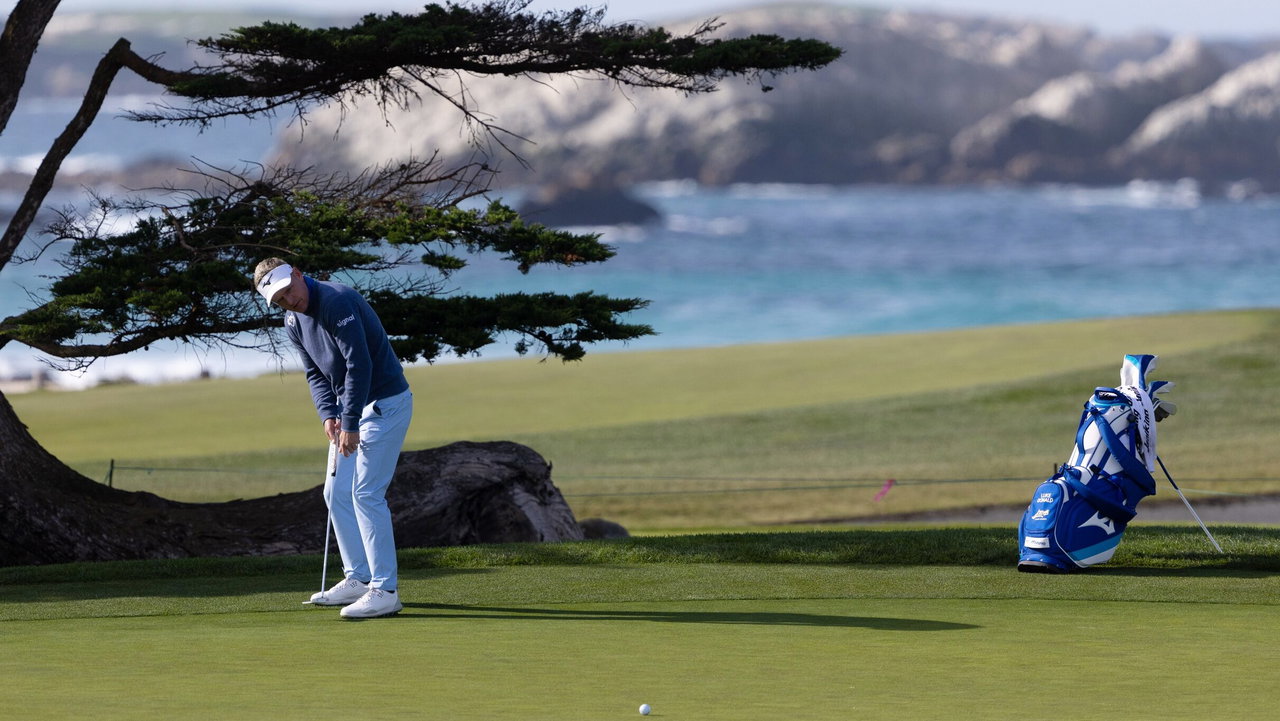
For decades, the 16th at Pebble Beach has asked golfers to think beyond the tee shot. The green sits in a natural dip, with two towering Monterey cypress trees narrowing the approach like goalposts. That look dates back to 1929, when H. Chandler Egan and Robert Hunter pushed the green more than 100 yards back into the property. The trees have been part of the challenge ever since.
Watch What’s Trending Now!
But on Friday, Ernie Els saw the hole a little differently. The four-time major champion hit a 3-wood and watched it carry all the way down the 16th. It was only one shot, but it got him thinking about what happens when today’s players keep hitting the ball farther, and what that could eventually mean for a course like Pebble Beach. Then there was the detail that had changed the hole in the first place: one of those two cypress trees, sitting roughly 90 yards short of the green, was gone.
“This golf course is arguably in the top five in this country and around the world, to be honest,” Ernie Els said in an interview with Golf.com on Friday. “It’ll be a shame if the golf course becomes a little not the way it was meant to play. Unfortunately, I know the USGA is trying to work on that golf ball, but it’s got to seriously happen quickly. You need to hit certain shots to certain holes. And with the ball flying this far, this golf course is going to get hurt.”
And the missing tree is only the latest reminder of how difficult it is to preserve the way Pebble Beach was meant to be played.
USGA wasn’t behind the removal of the iconic tree
The first thing to clear up is why the tree came down. There was no USGA order to remove it and no strategic decision to open up the 16th ahead of the 2027 U.S. Open. Pebble Beach said the cypress had become diseased and infested beyond recovery despite two years of treatment, and a local certified arborist recommended removing it to keep the problem from spreading to nearby trees.
That distinction matters because photos of the freshly sodded area and “ground under repair” signs quickly led to speculation that the change was part of the U.S. Open preparations. It wasn’t. The tree was removed because it was sick; the debate began over what its absence does to the hole.
When the news first broke, Justin Thomas wasn’t convinced. He went on a social media rant a few days ago after hearing about the change. With the right-side tree gone, Thomas saw more room for longer hitters to drive down that side and potentially turn the hole into a “bomb-and-gouge” exercise rather than the positioning test it had long been. He wrote: “Such a great hole. Makes no sense to me why they’d do this. When are places going to realize getting rid of trees is not the answer to making courses better, haha.”
“You know, we were thinking about taking driver out and just sending it,” Ryan Armour said. “I think the long guys can really take it on if they want.”
At the tournament itself, though, Armour opted to play the hole conservatively, laying up as they might have a decade ago rather than testing the newly opened right side. Zach Johnson did the same, suggesting that the change may be more noticeable on paper than it is in actual tournament play for now.
But not everyone was worried.
“I don’t think it’s that significant a change,” said Zach Johnson. “It’s unfortunate that the tree wasn’t in good health, and that’s what you got to do, but the integrity of the hole has not wavered.”
That difference in reaction is what makes the 16th interesting. The tree’s removal has created a new option, but it has not automatically rewritten the hole. The real question is what happens when the longest players in the game get the same option in a U.S. Open.
Why one tree matters at a course shaped by nature
Pebble Beach’s relationship with its landscape is part of what makes this change feel bigger than the loss of a single tree. The course opened in 1919 after Jack Neville and Douglas Grant routed it through the Monterey Peninsula, using the coastline, cliffs and natural contours as much as the architects’ own work. Years later, golf architect Robert von Hagge put the idea more bluntly: “God designed Pebble Beach.” Golf writer Mike Bailey made a similar point, writing that Pebble Beach had “God Almighty as its architect,” with Neville and Grant working with a piece of land that already supplied much of the drama.
That is also why the 16th’s history matters. Ahead of the 1929 U.S. Amateur, Egan and Hunter undertook a major redesign of Pebble Beach. They moved the 16th green more than 100 yards into a natural depression behind a grove of trees, transforming the hole’s approach and creating the narrow visual corridor players have dealt with for generations.
The trees were therefore not simply sitting beside the hole as decoration. They became part of the problem Egan and Hunter had created: players had to negotiate the fairway bunkers, position themselves and then send their approach through the opening toward the green. Remove one side of that frame, and the shot does not disappear, but the decision leading up to it can change.
Pebble Beach has lost notable trees before. The resort replaced the famous cypress in the middle of the 18th fairway this summer after the original was brought down by a 2014 storm. An earlier cypress near the 18th green had also died from pitch canker and was replaced in 2002. Those examples show that maintaining a historic course sometimes means replacing pieces of the landscape rather than simply preserving everything exactly as it was.
The 16th, however, presents a different problem because the missing tree affects a shot players make every time they play the hole.
The bigger problem hiding behind the missing tree
This is where Els’ concern goes beyond one cypress. Pebble Beach has already had to make other adjustments as modern players have gained distance. GOLF.com noted that a new tee was added on the 6th hole and that a second cypress was restored to the 18th fairway to bring back some of the strategic teeth that longer hitters had begun to blunt.
The difficulty is that Pebble Beach cannot simply keep stretching itself backward. Its holes and greens are tightly intertwined in what GOLF.com described as a “double-helix” routing, leaving limited room for wholesale expansion. That makes every adjustment more consequential: change a tee, move a bunker or lose a tree, and you are working within a course whose pieces already fit tightly together.
“You know, you need to hit certain shots to certain holes,” Els said. “With the ball flying this far, this golf course is going to get hurt.”
There is already a small test of that theory at the 16th. Ryan Armour considered taking driver and “just sending it.” Johnson and Armour ultimately chose the safer, familiar line. Next summer, with the U.S. Open field attacking the same hole, the calculation could look very different.
Pebble Beach has not ruled out putting another tree on the right side of the 16th before the championship. Until then, the missing cypress leaves behind an unusual question for one of golf’s most carefully preserved courses: how much can the hole change before players stop being asked to play the hole its designers intended?