
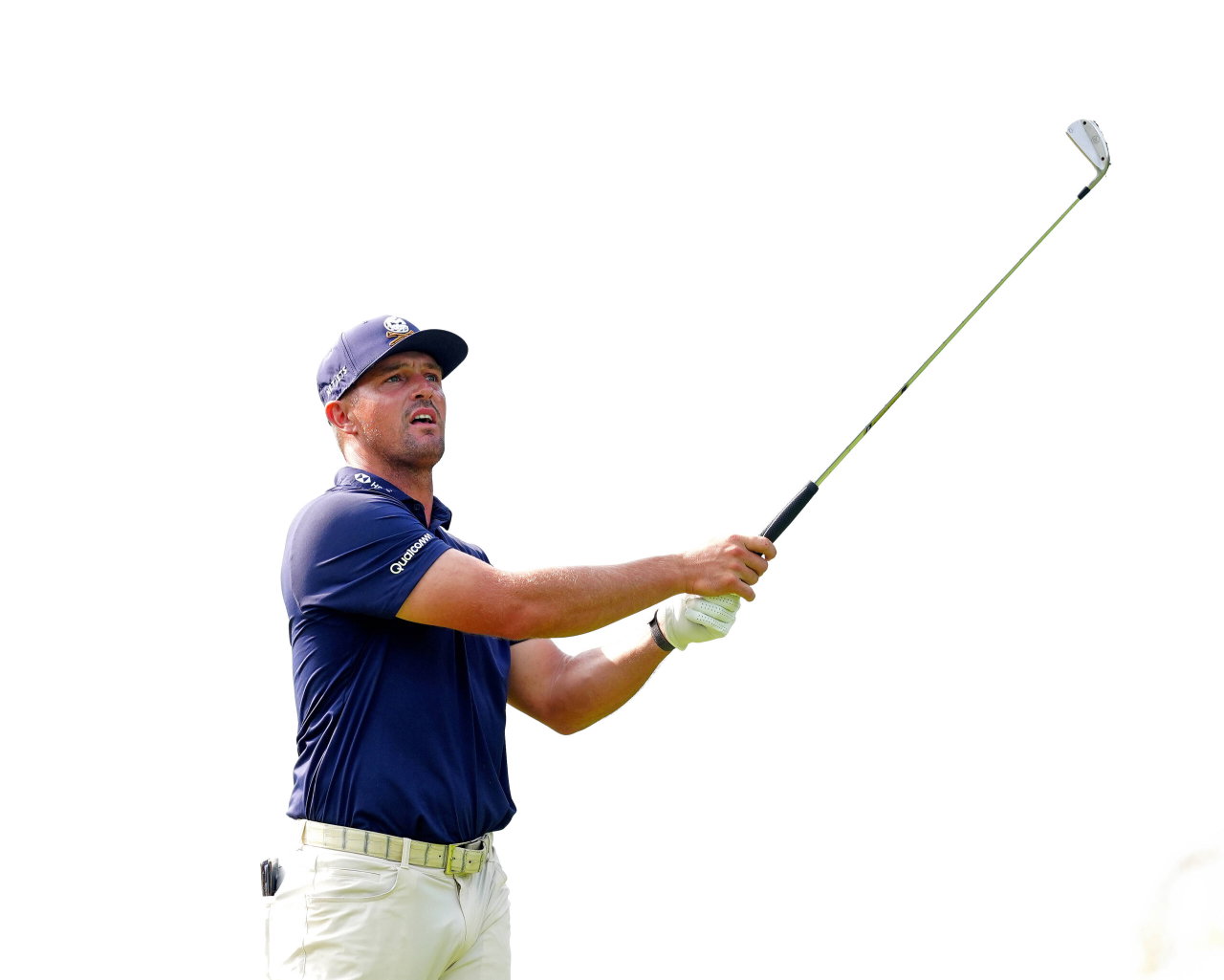
Brandel Chamblee has never been shy about sharing his strong opinions on Bryson DeChambeau. But in a recent podcast appearance, Chamblee offered a behind-the-scenes story from his time at Golf Channel that, in his view, helps explain where those opinions come from. The anecdote provides additional context for his long-running criticism of DeChambeau and sheds light on why Chamblee has continued to view the golfer through such a critical lens.
Watch What’s Trending Now!
Chamblee appeared on the From Pain to Promise podcast, where host Erin Kalin shared a clip from the conversation on Instagram. While Chamblee acknowledged DeChambeau’s immense ability, calling him “unbelievably talented,” he quickly shifted to a much more critical assessment of the golfer’s personality and behavior. “I also think he’s very immature and doesn’t have a lot of self-awareness,” Chamblee said.
Chamblee didn’t stop at his initial assessment. When asked what led him to that conclusion, he pointed to what he described as a pattern in DeChambeau’s behavior and public comments. “Just the way he behaves, the things he says,” Chamblee said, before citing DeChambeau’s reaction to a ruling at the Open Championship as one example. In Chamblee’s view, incidents like that have repeatedly reinforced his belief that DeChambeau lacks self-awareness.
The incident Chamblee was referring to came at the 2026 Open Championship at Royal Birkdale, where DeChambeau received a two-stroke penalty during the second round. His drive on the par-4 fifth hole landed in thick rough, and as he assessed the lie, footage showed him moving through the grass around the ball. The R&A determined that his actions had improved the area of his intended backswing under Rule 8.1, resulting in his score being changed from 66 to 68. The penalty dropped DeChambeau from second place to a tie for fifth, three shots behind the leader. DeChambeau spent about 15 to 20 minutes contesting the penalty with officials before they upheld it. It was that prolonged dispute, in particular, that Chamblee pointed to as an example of the behavior that has shaped his view of DeChambeau.
Chamblee was equally clear about where he stood on the ruling when he later discussed the incident on Golf Channel. Asked whether DeChambeau deserved the penalty, he said there was no doubt in his mind. Chamblee explained that Rule 8.1 prohibits a player from moving, bending, or breaking objects around the ball when doing so improves the conditions affecting the stroke. From his perspective, DeChambeau’s actions clearly altered the area around the ball in a way that fell under the rule, making the penalty justified in his view.
Paul McGinley also criticized DeChambeau, though his focus was less on the ruling itself and more on how the LIV Golf star handled the aftermath. McGinley argued that DeChambeau did little to help his own case by refusing to accept the penalty calmly, while also noting that players can put themselves in difficult situations when their actions around the ball leave room for questions over the rules. In McGinley’s view, DeChambeau’s handling of the grass created precisely that kind of situation, making the controversy about more than just the penalty itself.
The penalty also cast some uncertainty over whether DeChambeau would return for the third round. According to Golf Channel, he was reportedly unsure about continuing, with his agent, Brett Falkoff, saying the decision was still being discussed. DeChambeau eventually put those questions to rest himself on social media, expressing his disappointment with the ruling and making clear that he disagreed with it. However, rather than walking away, he said the decision motivated him to keep going and compete through the weekend.
Rather than leaving immediately after the lengthy rules discussion, DeChambeau stayed at the course and returned to the practice range, putting in additional work as he prepared to continue the tournament.
Chamblee’s comments on the Kalin podcast also made it clear that his frustration with DeChambeau predates the Royal Birkdale incident. He recalled a behind-the-scenes episode involving Golf Channel reporter Todd Lewis in the lead-up to the 2025 U.S. Open at Winged Foot, when DeChambeau arrived as the defending champion following his victory at Pinehurst No. 2 in 2024.
According to Chamblee, Golf Channel had invested heavily in producing a major profile on DeChambeau, with the piece completed and scheduled to air during U.S. Open week. However, when DeChambeau asked Lewis to review the story before broadcasting it, Lewis declined. Chamblee said DeChambeau became upset following the refusal, and the piece was ultimately pulled from the schedule. According to Chamblee, DeChambeau aimed to shape the story’s presentation and the editorial decisions behind it.
Chamblee also pointed to DeChambeau’s U.S. Open victory speech at Winged Foot as another moment that shaped his opinion of the golfer. He took issue with DeChambeau thanking his sponsors before turning his attention to the significance of the victory, arguing that leading with commercial acknowledgments distracted from the achievement of winning a major championship.
Chamblee’s criticism of DeChambeau had continued into 2026, with another example coming in the buildup to The Open at Royal Birkdale. Chamblee suggested that DeChambeau had shifted some of his competitive focus away from players such as Scottie Scheffler and Rory McIlroy and toward YouTube creator Grant Horvat, reflecting Chamblee’s view that DeChambeau was devoting too much attention to his content career. At the time, DeChambeau had also missed the cut in the first three majors of 2026—the Masters, the U.S. Open at Shinnecock Hills, and the PGA Championship at Aronimink. The penalty at Royal Birkdale added another difficult chapter to his season, although DeChambeau ultimately stayed in the tournament and returned for the weekend.