
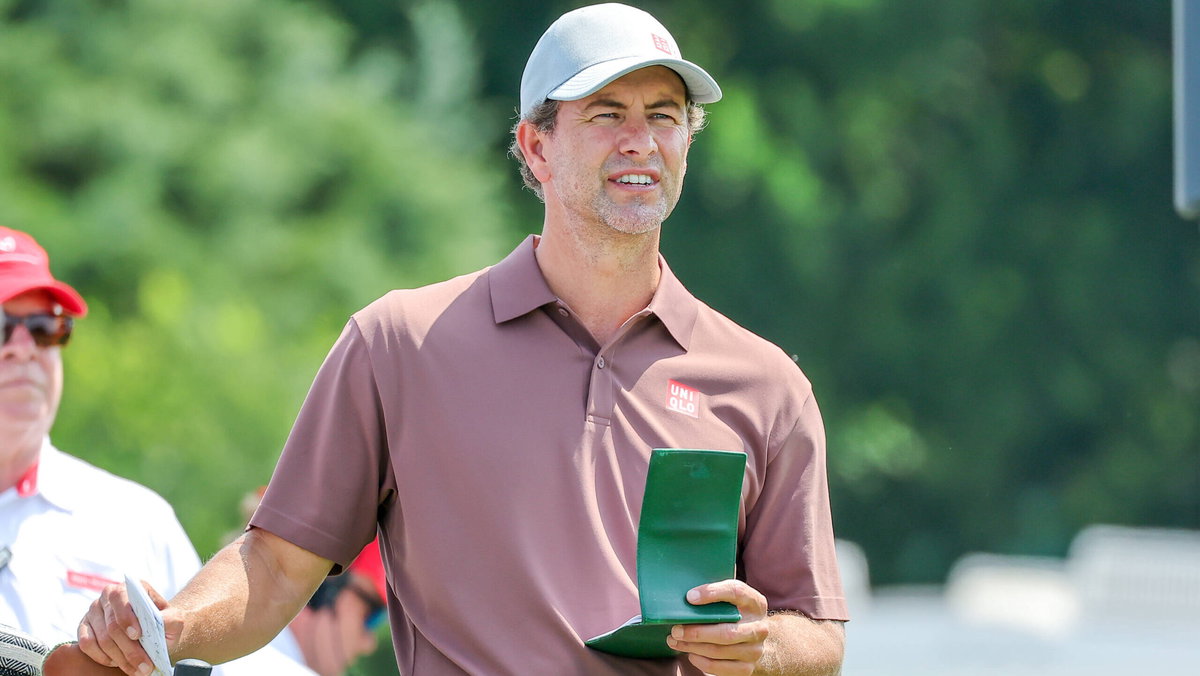
The PGA Tour’s return to Trump National Doral after a decade away felt like a full-circle moment for Adam Scott. As the winner of the last major event held at the Blue Monster in 2016, Scott entered the $20 million Cadillac Championship as a veteran with both the course knowledge and the current form to contend. His iron play has been a statistical standout in 2026, and early in his opening round, he looked every bit the favorite. However, in a game where precision is paramount, his momentum was suddenly derailed, not by an errant swing or Doral’s infamous water hazards, but by a simple, avoidable mental lapse that proved even the most seasoned champions are not immune to the sport’s technical traps.
Watch What’s Trending Now!
It happened on the par-5 eighth, a 582-yard hole that should have been straightforward enough. Scott’s drive drifted into the left rough, and after walking up to what he thought was his ball, he played his second shot. Only then did he realize he’d made a massive mistake. Rules official Nico Pearson reviewed the play and confirmed the bad news: it was a violation of Rule 6.3c. Because he played the wrong ball, Scott was hit with a two-shot penalty.
The Aussie found his actual ball nearby, played from the correct spot, and took the penalty before teeing off on the ninth hole, a necessary step, as failing to rectify the error would have meant immediate disqualification. The hot mics caught his genuine confusion: “This is where I hit from. I thought that was around.”

That's not the right ball 😬 A nightmare at No. 8 for Adam Scott as he plays the wrong ball @Cadillac_Champ. 📺 PGA TOUR LIVE on ESPN+
He wasn’t thinking about his swing or the distance. He simply assumed, with quiet confidence, that he knew where his ball was, only to find out he was wrong. In golf, the rules don’t consider your intentions. Now, one might think this is a rookie mistake, but Adam Scott is far from the first pro to fall into this trap.
Even the best have mental lapses, like Akshay Bhatia at the Hero Indian Open this past March. Despite arriving as the highest-ranked player in the field, Bhatia’s focus slipped during a rough opening round. On the 15th hole, he played the wrong ball only to find his own sitting just a few feet away. Like Scott, the two-shot penalty was devastating; it led to a triple-bogey and a front-nine 44, eventually causing him to miss the cut.
Interestingly, Scott and Bhatia are not the only top players to see a rules mistake change the outcome of a round. While they were undone by hitting the wrong balls, golf history is full of small mistakes with massive consequences. And Dustin Johnson’s heartbreak at the 2010 PGA Championship is the perfect example. Leading on the final hole, he grounded his club in a tiny patch of sand he thought was just a trampled waste area. That two-stroke penalty knocked him out of a playoff and haunted his career for years. Tiger Woods faced a similar disaster at the 2013 Masters. An improper drop on the 15th hole cost him his momentum and turned the tournament favorite into the center of a disqualification controversy.
As for Adam Scott, aside from the double bogey on the eighth, his opening round was a frustrating case of what could have been. He started strong, looking like his 2016 championship self with two smooth birdies through the first five holes to climb near the top of the leaderboard. His iron play was sharp, which makes sense for a guy ranking third on Tour in Strokes Gained: Approach, but his momentum vanished the second he was penalized. The back nine was a total grind, as he failed to card a single birdie while struggling on Doral’s tough greens. He eventually signed for a 4-over 76, dropping from a potential top-ten spot to a tie for 66th near the bottom of the pack.
This scorecard is a blunt reminder that the Blue Monster punishes a lack of focus just as much as a bad swing. At Doral, a single mental lapse creates a fatigue that makes every hole feel like a battle. Once that rhythm is broken, the course offers no easy way back, proving it is as much a test of mental stamina as it is of ball-striking.
Blue Monster is a mental grind
The “Blue Monster” reputation isn’t just marketing; it is a psychological grind that wears down the field through a relentless series of high-stakes decisions. With water coming into play on nearly half the holes and fairways that seem to shrink the moment the Florida wind kicks up, the course demands a level of mental stamina that many modern venues lack.
“It’s a challenge. It’s called the Blue Monster for a reason,” Adam Scott gave his verdict before the event even started. “It’s a big golf course, very penal.” He explained how demanding it is from the tee to the green. However, it is only after the first round that everyone else understood how much truth there is in it.

#1 player in the world btw.
The opening round of the 2026 Cadillac Championship proved exactly how demanding this test remains. While Cameron Young managed to solve the puzzle with a spectacular 8-under 64, the rest of the elite field found themselves in a grueling battle for par. Even Scottie Scheffler, the world number one known for his unflappable consistency, admitted to feeling “a touch off” as he fought his way to a 1-under 71. Scheffler noted that when your game isn’t perfect at Doral, the course offers no opportunities to “steal shots” back from the scorecard. Instead, it forces players into a defensive shell.
The course can still be rewarding, though. Jordan Spieth proved that by finding his rhythm and carding an incredible 65, showing that a low score is possible if you can stay locked in.
Ultimately, the day was defined by how quickly a small lapse in focus can snowball. While Adam Scott’s mistake was a specific rules violation, veterans like Justin Rose (74) found that the Blue Monster simply waits for your mental discipline to crack. Whether it’s a penalty or a hazard, Doral remains a place where the smallest error can turn a great round into a long afternoon.