

The WNBA Finals feature the league’s most valuable franchise against its least valuable, and the series is tied. Golden State won Game 1, 68–64, at Chase Center, but Atlanta bounced back with a 79–65 victory in Game 2. The win marked the first Finals victory in Dream history after the team started the series 0–10. It also handed the Valkyries their first home loss of the postseason. The series now moves to Atlanta for Game 3 on Wednesday night. Now, beyond the action on the court, the Finals have brought attention to several compelling stories.
Watch What’s Trending Now!
Two weeks ago, Yahoo Sports’ Dylan Dittrich highlighted some of the stories behind the Golden State Valkyries’ rise. One notable achievement is that the team has sold out every home game it has ever hosted. The Valkyries also finished with the league’s second-best record in just their second season, an impressive feat for a franchise that didn’t exist three years ago.
The Valkyries’ rapid rise is just one part of the bigger picture. Both the Golden State Valkyries and the Atlanta Dream have interesting business stories of their own, offering a closer look at the teams beyond the Finals spotlight.
The Valkyries have become the first to join a stellar club
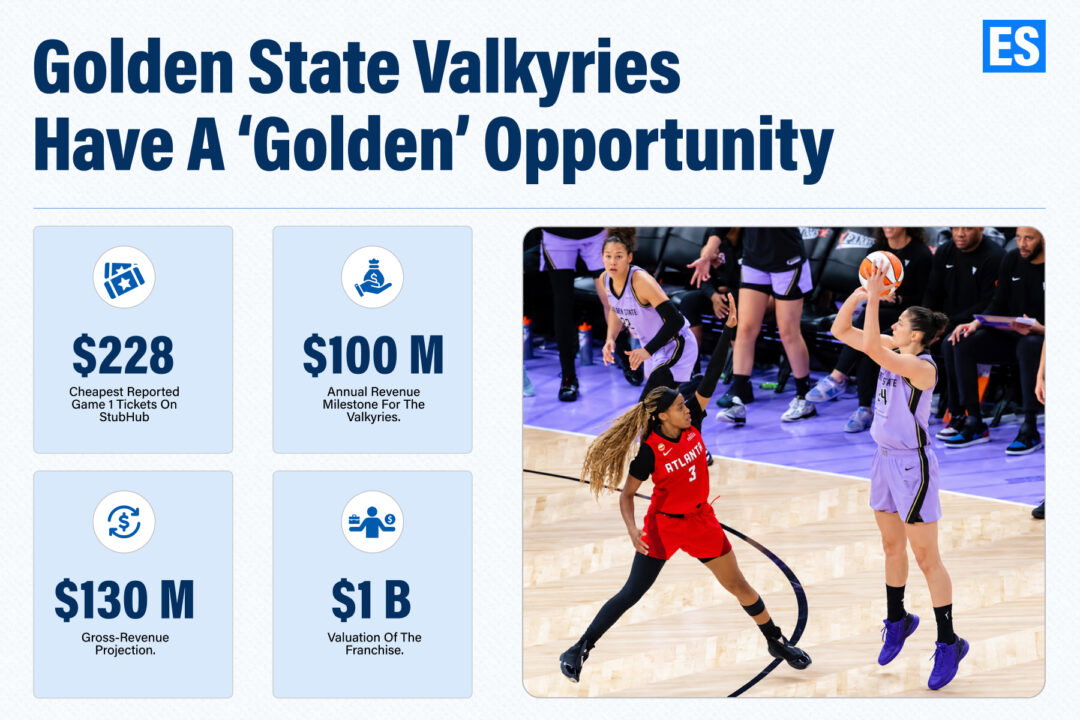
According to Sportico, the Golden State Valkyries generated more than $100 million in revenue during the 2026 regular season. They became the first WNBA team and the first women’s professional sports team to reach that mark. The figure does not include playoff revenue.
- Fast growth: The Valkyries generated $78 million in revenue during their first season, setting a record for a women’s sports team at the time. That was 48% more than the Indiana Fever, who finished second at an estimated $53 million. The increase from $78 million to more than $100 million represents growth of about 28% in one year.
- Their share of league revenue: The WNBA’s 13 teams generated an estimated $410 million in 2025. The Valkyries’ $78 million accounted for about 19% of that total. It was roughly 2.5 times the average team revenue of $31.5 million.
- What drives demand: The Valkyries have sold out 47 consecutive regular-season games at Chase Center, which holds 18,064 fans for basketball. They also have sponsorship deals with more than 40 brands, and their season-ticket base exceeds 10,000. Their partners include United Airlines, Kaiser Permanente, AT&T, and Chase. The franchise also shares ownership with the NBA’s Golden State Warriors.
Revenue and franchise value are two different things. Revenue is the money a team brings in, while valuation is an estimate of what the franchise is worth.
Imago
Image Courtesy: IMAGO
- CNBC valued the Valkyries at $1 billion in May, while Sportico put their value at $850 million. Based on their 2025 revenue, those figures represent roughly 13 times and 11 times revenue, respectively.
- Applying those same multiples to $100 million in revenue would suggest a valuation of $1.1 billion to $1.3 billion. However, that is an estimate based on the calculations, not an officially reported valuation.
- Warriors owner Joe Lacob agreed to pay a $50 million expansion fee for the team in 2023. A valuation of $850 million would be 17 times that amount, while a $1 billion valuation would be 20 times higher.
Revenue also does not equal profit. The Valkyries may be bringing in more money, but their costs have risen as well.
Under the new collective bargaining agreement, the WNBA salary cap increased from $1.5 million to $7 million, more than four times its previous level. Sportico reported that several teams were profitable last year under the lower salary cap.
There is no public report confirming the Valkyries’ operating profit. Arena expenses and the details of league revenue-sharing agreements are also not publicly available.
The WNBA Finals mean many things for the Dream
While the Valkyries are setting revenue records, Atlanta is trying to build its business after years of playing in a much smaller arena.
- Where they stand: Sportico ranks the Dream last among the WNBA’s 13 teams, with an estimated value of $280 million. That is roughly one-third of the Valkyries’ $850 million valuation.
- A return to the Finals: This is the Dream’s fourth WNBA Finals appearance and their first since 2013. The team now has an opportunity to use its postseason run to build a stronger connection with fans.
- Rising revenue and attendance: Sportico reported that the Dream expected their revenue to double in 2026. The growth is being supported by games at State Farm Arena and the addition of Angel Reese. The team’s average attendance rose by over 50%, the largest increase in the league.
Reese scored 30 points and grabbed 16 rebounds in Game 2. She also became the youngest player in WNBA history to record at least 20 points and 10 rebounds in a Finals game.
- The opportunity ahead: A championship run could improve the Dream’s brand recognition, increase repeat ticket sales, and attract new sponsors. Their move to State Farm Arena for the 2027 season will give them a larger venue to build on that momentum.
- A different starting point: The Dream have spent years playing in one of the league’s smallest arenas and do not have an official partnership with the Hawks. Their path is different from Golden State’s, so the two franchises should not be expected to follow the same business model.
Why the Dream Moved to the Hawks’ Arena
The Atlanta Dream moved Games 3 and 4 of the Finals to State Farm Arena to accommodate more fans. Game 6, if necessary, remains currently scheduled for Gateway Center Arena, the team’s usual 3,500-seat home.
- A much larger venue: Gateway Center Arena holds about 3,500 fans for basketball, while State Farm Arena can accommodate more than 17,000. That gives the Dream roughly five times as much seating. Across two games, the larger venue offers about 34,000 seats, compared with around 7,000 at their usual arena.
- Why the move required negotiations: Games 3, 4, and 6 conflicted with events already scheduled at State Farm Arena. Unlike some other WNBA teams, the Dream do not have a partnership with the Hawks or the arena. The Hawks agreed to delay their home opener by 30 minutes to help make the arrangement work.
- Evidence of demand: The Dream played their postseason home games at State Farm Arena, drawing an average of 9,745 fans. For those games, they opened the lower bowl and part of the upper bowl, providing about 8,800 seats. For Games 3 and 4, they will open the entire arena. The team also sold out State Farm Arena five times during the regular season. Reported get-in prices for Games 3 and 4 are $85 and $95, compared with $214 or more in San Francisco. However, the prices come from different markets and stages of ticket sales.
- A permanent change ahead: The Dream have signed a multi-year agreement to play all their home games at State Farm Arena beginning in 2027.
Moving to a bigger arena gives Atlanta more opportunities to earn money from ticket sales, concessions, and sponsorships. However, the team will also face rental and staffing costs, and the financial terms of the agreement have not been made public.
To illustrate the potential ticket revenue, an average ticket price of $100 across 27,000 additional seats would generate about $2.7 million in gross ticket sales over two games. This is only a hypothetical calculation, not a reported revenue figure.
The contrast with Golden State is clear. Atlanta needs more seats to meet demand, while the Valkyries are already selling out their large arena. In San Francisco, demand is reflected in ticket prices because the team has limited room to accommodate more fans.
If the Finals go seven games, Golden State would host Games 1, 2, 5, and 7 at Chase Center. Those four games would provide about 72,000 seats. Atlanta would have roughly 37,500 seats across its three potential home games, based on the capacities used here.
What a Finals run could mean for the Valkyries
Sportico projected that the Valkyries could generate more than $130 million in gross revenue with a run to the Finals before the league takes its share of playoff gate receipts.

Imago
SAN FRANCISCO, CA – OCTOBER 17: Gabby Williams 1 of the Golden State Valkyries scores against Rhyne Howard 10 of the Atlanta Dream during Game One of the WNBA, Basketball Damen, USA Playoff Finals on October 17, 2026 at Chase Center in San Francisco, CA. Photo by Matthew Huang/Icon Sportswire WNBA: OCT 17 Finals Atlanta Dream at Golden State Valkyries EDITORIAL USE ONLY Icon261017026
That would be about $30 million, or 30%, above their regular-season revenue of more than $100 million. It would also represent an almost 67% increase over the $78 million they generated in 2025. This is a projection, not a confirmed final total.
- Where the extra money comes from: Additional home games, premium seating, merchandise, sponsor activations, and greater national exposure can all help increase revenue.
- Growing audiences: The first round of the 2026 WNBA playoffs averaged 1.3 million viewers, making it the most-watched opening round in league history. Viewership increased 37% from 2025.
- Long-term value: Based on the valuation multiples discussed earlier, the Valkyries would need annual revenue of roughly $156 million to support a $2 billion valuation using a multiple of about 12.8 times revenue. Winning a championship could also help the team renew sponsorship deals and attract more fans after the excitement surrounding a new franchise begins to settle.
- What to watch: Golden State’s loss in Game 2 makes the possibility of a Game 5 or Game 7 at Chase Center more important. Those games could provide additional revenue opportunities if the series returns to San Francisco.
Ticket prices reflect the growing interest
Demand for the Finals has pushed ticket prices to unusually high levels, especially for games at Chase Center.
- StubHub averages: StubHub reported that the average price for Game 1 was more than four times the price of last year’s Finals opener and more than three times the price of the 2024 opener. It was also more than double the previous high, set in 2024. StubHub described this as the most expensive WNBA Finals on its platform in at least six years.
- Cheapest available tickets: TicketIQ put the average get-in price for Games 1 and 2 at $220, nearly four times last year’s level. TicketData listed the cheapest Game 1 ticket at $214. Another report cited a $228 starting price for a Thursday listing that included standing-room-only access. Prices vary by marketplace and when the tickets are checked.
- The price range: Verified resale tickets listed on the Valkyries’ own website ranged from $206 for upper-bowl seats to $6,490 for courtside club seats.
- Season-ticket holders: One season-ticket holder said his per-game cost increased from $50 during the regular season to $65 in the first round, $95 in the semifinals, and $175 for the Finals. Valkyries president Jess Smith acknowledged that the team set postseason prices with high demand in mind. One goal was to prevent resellers from making large profits on tickets priced too low by the team.
- Comparison with the NBA Finals: The cheapest ticket for Game 1 of the 2022 NBA Finals at Chase Center started at $697, more than three times the price of the cheapest ticket for this WNBA Finals matchup. TicketData and TickPick reported that the get-in price for a potential Game 7 could reach around $416 or more.
Resale prices do not all go to the team. The team receives the original ticket price, while additional money from resale generally goes to sellers and ticketing platforms.
The claim that these are record ticket prices also depends on the measure used. Game 2 of the 2024 WNBA Finals had a get-in price of $225, slightly higher than the $214 starting price reported for this year’s Game 1. StubHub’s record claim is based on average prices on its platform over six years, not every ticket marketplace.
There’s a lot more going on behind the scenes
The Finals reflect a wider trend across the WNBA, with attendance, team valuations, and media revenue all growing.
- Attendance: The WNBA drew a record 3.79 million fans in 2026. The Valkyries averaged 18,064 fans per game, filling Chase Center for their home games.
- Franchise values: The average WNBA team is worth an estimated $427 million, up 59% from last year and 345% since 2024. The average values of teams in other major U.S. leagues remain much higher. Sportico puts the averages at $7.13 billion for the NFL, $5.51 billion for the NBA, and about $3 billion for MLB.
- Media and sponsorship revenue: The WNBA’s $2.2 billion media deal is taking effect. Teams received at least $3 million in central media and sponsorship revenue in 2025, with that amount rising to at least $6 million in 2026.
Can other teams follow the Valkyries’ model? Some of Golden State’s advantages are difficult to replicate, including its Warriors ownership, access to a major arena, the Bay Area market, and an established basketball audience.
However, the Valkyries are not the only team experiencing strong growth. Sportico reported that Portland’s revenue was expected to exceed $40 million.
The Finals highlight how demand can outgrow a team’s available seating and how that demand can give franchises more control over ticket prices. The bigger question is whether teams can keep increasing revenue faster than their costs.