
The NFL is cashing in money, and all 32 teams are enjoying it. The league earned $14.5 billion in shared revenue last season, and each team got $453.2 million, regardless of its size, popularity, or market. But how does this system actually work?
Watch What’s Trending Now!
These figures were revealed in the Green Bay Packers’ annual financial report on July 24, 2026. Each team’s share increased by 4.8% from the previous season, showing that the NFL’s growing earnings benefit every franchise. Media rights and league-wide sponsorship deals are major sources of this shared income, giving all teams a strong financial base.
But here’s the real question: How does the NFL balance equal revenue sharing with the ability of bigger-market teams to earn more?
The $14.5 Billion Revenue Pool: Where Does the Money Come From?
Broadcasting and media rights are the NFL’s biggest sources of income. The league has signed deals worth nearly $110 billion with CBS, NBC, FOX, ESPN, and Amazon to show its games through the 2033 season.
On top of it, the NFL can also leave most of these agreements after the 2029 season and negotiate new ones.
The NFL also earns money through NFL Sunday Ticket. YouTube reportedly pays around $2 billion per year for the right to show games to residential viewers over seven seasons, depending on subscriber targets.
Commercial venues such as bars and restaurants bring in another reported $150 million–$200 million annually.
DAZN has acquired EverPass Media, which handles Sunday Ticket’s commercial distribution in the US.
Let’s break it down for the previous year. Through shared revenue, the league earned $14.5 billion, which accounted for 62% of total team revenue.
Then they added another $4.35 billion from tickets and luxury suites, which was 19% of revenue.
Sponsorships generated $2.6 billion, or 10% of total revenue. For example, the Dallas Cowboys led the league with around $300 million in sponsorship earnings.
And in the end, concessions, parking, team stores, and other events added $1.7 billion.
Now, let’s dig deeper and see how the league distributes this amount.
How Revenue Sharing Works Across 32 Teams
The NFL earns money through various ways, including national TV deals, sponsorships, licensing, and merchandise.
Then the league puts all of this money together and divides it equally among all 32 teams. So, each team gets the same amount; it has nothing to do with anything.
The NFL introduced equal sharing of national television revenue in 1961, under Commissioner Pete Rozelle. The main reason was to prevent teams in smaller markets from falling behind financially.
Teams in big cities like New York, Los Angeles, and Dallas have more chances to earn money from local businesses and sponsors than smaller-market teams.
Green Bay is a good example of it. Even though it is a much smaller market, the Packers received the same $453.2 million in shared revenue as every other team in 2025.
This gives them a strong financial base before earning additional money from ticket sales, stadiums, and local sponsorships.
But things are different for other sports like MLB.
MLB teams depend more on local income than NFL teams, especially money from local TV deals. According to Sports Business Journal, around 25% of an MLB team’s total revenue comes from media rights. Also, nearly 80% of baseball viewing happens through regional sports networks (RSNs) and other local broadcasters.
Now, let’s dig into how NFL teams earn locally.
The Local Revenue Battle, Where Teams Make Their Own Money
Ticket sales and premium seating are one of the main reasons behind local income for NFL teams. In 2024, the 49ers led with $176 million in net gate receipts, followed by the Cowboys ($136M), Eagles ($130M), Broncos ($129M), and Dolphins ($127M). The Titans earned the least among these teams at $81 million.
The Cowboys also benefit from their strong brand and AT&T Stadium. Their stadium creates income through luxury suites, premium seating, and major events. The difference is pretty clear compared to other teams.
One example is the Green Bay Packers. The Packers reported $299.8 million in local revenue in 2025, while the Cowboys generated more than $800 million in local revenue, as per an August 2025 Sports Business Journal report.
And this difference comes in despite the NFL’s equal revenue-sharing model, because local income varies for different teams. And the Packers face an up-and-down situation from last year’s earnings.
Let’s dig into the Packers’ earnings.
The Packers’ Rare Look Inside the NFL’s Finances
The Green Bay Packers reported $753 million in total revenue in 2025, including $453.2 million from the NFL’s national revenue sharing and $299.8 million from local activities such as ticket sales and sponsorships.
However, earning more money does not always mean making a profit. The Packers recorded a $1.1 million operating loss because their expenses reached around $754 million, up 19% from the previous year. The biggest reason was player spending, which increased by approximately $130 million. Higher costs from stadium improvements also added to their expenses.
Despite this loss, the Packers finished with $132.5 million in net income, up 55% from the previous year. This was possible because they earned an additional $133.6 million from investments.
The Packers face another financial challenge because of their ownership structure. Unlike privately owned teams, they cannot sell shares to outside investors to raise money. Packers CEO Ed Policy highlighted the Miami Dolphins as an example. They raised $125 million by selling just a 1% stake to billionaire Lin Bin at a $12.5 billion valuation.
To bring in more money, the Packers plan to host additional concerts and college football games, attract new sponsors, and increase ticket prices. These steps will help the team grow its local revenue and remain financially strong.
But does this approach really work for NFL teams?
Revenue sharing strengthens the NFL by giving all 32 teams an equal share of national income, and the Packers situation is a live example of it.
On top of that, revenue sharing provides a steady income, while the cap limits player spending. And it’s clearly visible in teams’ success.
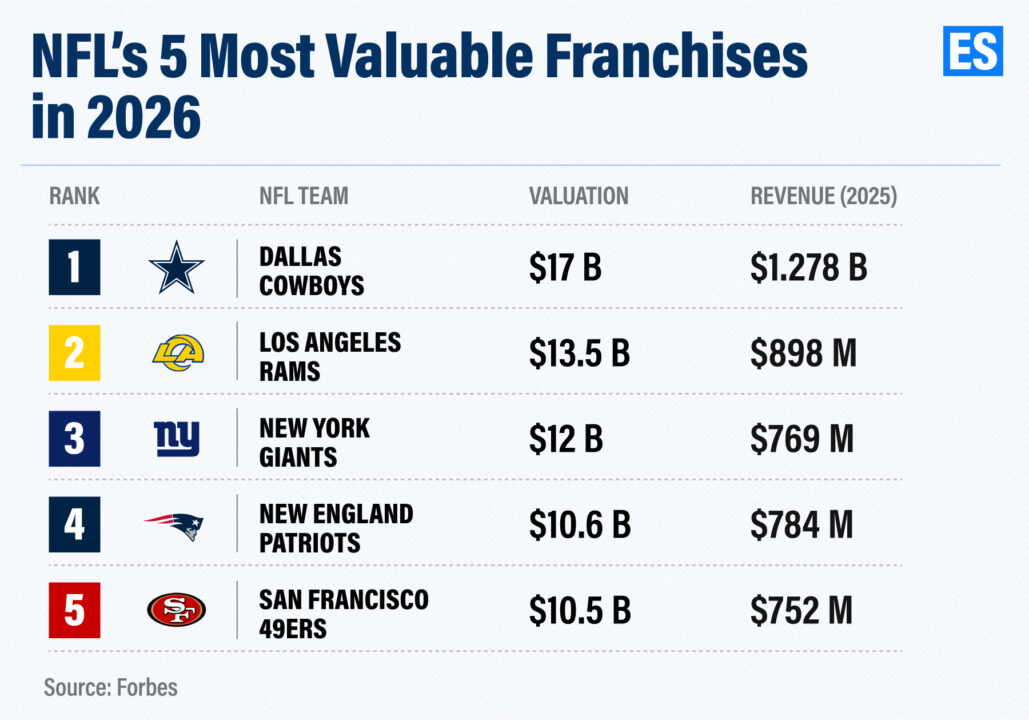
The Dallas Cowboys lead the league at $17 billion. Their value increased by 31% in one year, while the average NFL team is now worth $9.5 billion, up 34% from 2025. Even the Cincinnati Bengals, the least valuable team, are worth $8 billion.
This steady income also supports franchise values and makes teams more attractive to investors.
Now, through this revenue-sharing model, it will be interesting to see if the numbers keep on increasing or reach saturation.