
Imago
Image Courtesy: Imago
Imago
Image Courtesy: Imago
The sports world has barely had time to process Mark Walter’s sale of the Los Angeles Lakers just over a year after he acquired a majority stake from the Buss family. Now, the spotlight has shifted to Minnesota, where the Timberwolves and Lynx could be heading toward a major ownership change.
Watch What’s Trending Now!
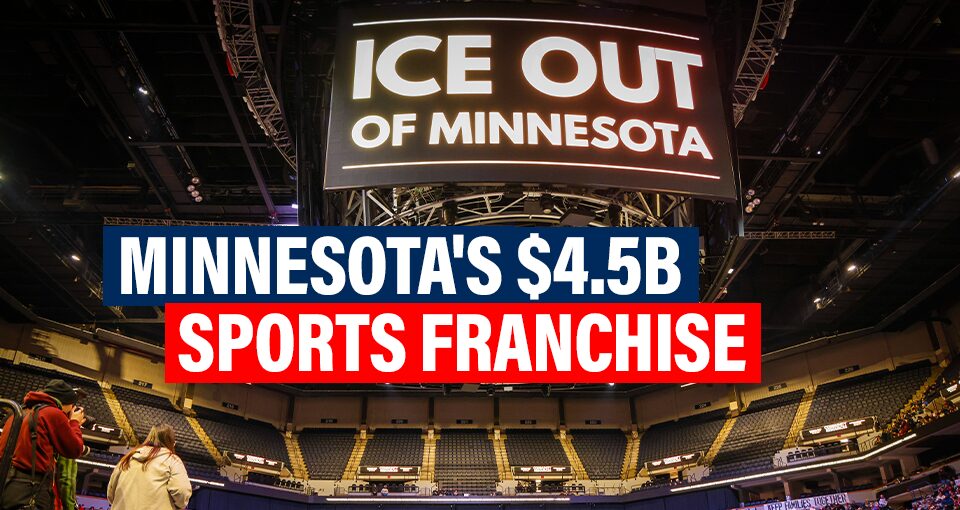
The claim is that Marc Lore is selling his controlling stake in the Minnesota Timberwolves and WNBA’s Minnesota Lynx to billionaire investor Marc Stad, in a deal that values the two franchises at a combined $4.5 billion. And this deal matters for several reasons.
Notably, Lore fully took control of the franchises in June last year after a prolonged dispute over his purchase of the teams from Glen Taylor. When Lore and Alex Rodriguez agreed to acquire the Timberwolves and Lynx in 2021, the deal valued the franchises at $1.5 billion. Now, just five years later, that valuation has nearly tripled. The Lakers have followed a similar trajectory.
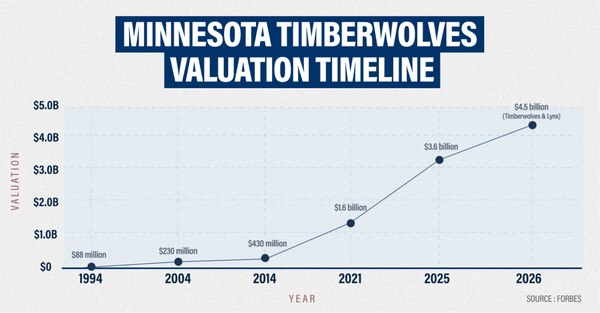
When Walter bought the franchise from the Buss family last summer, the deal valued the team at $10 billion. Today, that valuation has reportedly climbed to $12.5 billion, representing a roughly $2.5 billion increase in just one year. That brings us to the bigger question: What exactly are investors paying for when sports franchise valuations are rising this quickly?
The possible factors attracting investment in Minnesota
The Minnesota Timberwolves have become a much better team in recent years. Since Alex Rodriguez and Marc Lore became owners, the team has made the playoffs five years in a row. They have also made deep postseason runs, including back-to-back appearances in the Western Conference Finals in 2024 and 2025.
That success has clearly helped the team’s business. A winning team typically sells more tickets, attracts better sponsors, draws more fan attention, and becomes more valuable to potential buyers. But there’s more to it.
- The bigger story is that NBA franchises, in general, have seen their valuations skyrocket.
- Boston Celtics were valued at $6.1 billion when they were sold in 2025, a year after their 18th championship.
- Buyers are willing to pay significantly more for NBA franchises across the board, regardless of whether a team is dominating on the court.
So, the Timberwolves’ playoff success probably added some extra value, potentially hundreds of millions of dollars. But most of the roughly $3 billion increase in their valuation came from the broader growth of the NBA. At the same time, we can’t ignore two other major factors: the league’s media deal and the scarcity of NBA ownership.
Media deals and the scarcity of NBA ownership
The NBA’s new $76 billion media deal with Disney, NBCUniversal, and Amazon means the league will bring in a massive amount of money from television and streaming. A significant portion of that money eventually flows to the teams.
So, even if the Timberwolves hadn’t suddenly become a much better team, their financial value still would have increased because owning an NBA franchise now means owning a larger share of a much bigger business. And then there’s the scarcity of NBA ownership. This may be the most important factor of all.
There are only 30 NBA franchises. The league can’t simply create 100 more teams because thousands of wealthy people want to buy one. And NBA teams rarely come up for sale. Imagine there are just 30 luxury homes in a neighborhood, but thousands of billionaires want to own one. What happens? Prices go up.
That’s essentially what’s happening with NBA teams.
- More wealthy individuals, investment groups, and corporations are looking to own sports franchises.
- But the number of NBA teams remains extremely limited. That creates a simple equation: more buyers + very few teams = higher prices
The NBA may eventually add two expansion teams, but that decision isn’t expected until later this year. Until then, the supply of franchises remains extremely limited. And because NBA teams have become so expensive, one billionaire doesn’t necessarily have to buy an entire franchise. Instead, multiple wealthy investors can come together to purchase pieces of a team.
That’s why we’re seeing larger ownership groups, investors buying minority stakes, wealthy individuals buying into teams without having full control, and sellers finding creative ways to bring more investors into the fold. And in Minnesota, there’s another interesting wrinkle: two leagues are part of the same deal.
The Lynx go from an add-on to a valuable asset
Imago
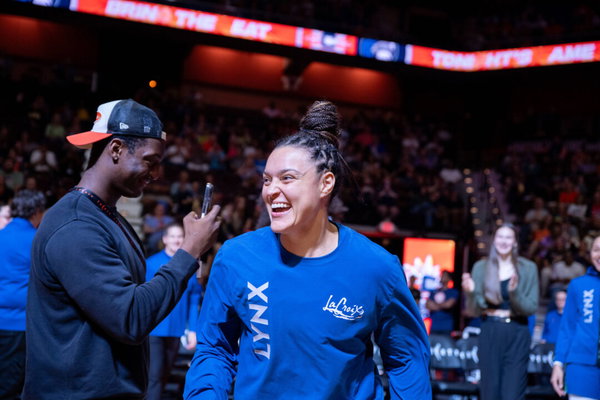
Minnesota Lynx V Connecticut Sun Kayla McBride 21 of the Minnesota Lynx is introduced in the starting lineup before the WNBA, Basketball Damen, USA game between the Minnesota Lynx and the Connecticut Sun at Mohegan Sun Arena in Uncasville, Connecticut, on July 8, 2026. Uncasville United States PUBLICATIONxNOTxINxFRA Copyright: xEricaxDenhoffx originalFilename:denhoff-minnesot260708_nps9S.jpg
Five years ago, the Lynx were essentially a small add-on to the Timberwolves’ $1.5 billion sale. The market didn’t assign much separate value to the WNBA team. That started to change in 2025, when Sportico valued the Lynx separately at $240 million, up from $85 million. It was a clear sign that investors were beginning to see the Lynx as a valuable business in its own right.
- In 2025, Forbes valued the Lynx at about $230 million.
- The following year, CNBC ranked the Lynx No. 8 among WNBA teams as the average WNBA franchise reached roughly $460 million in value.
- Ultimately, the latest Timberwolves ownership deal reportedly valued the Lynx at $320 million on its own.
That’s perhaps the biggest change in this entire story. In 2021, the Lynx was mostly an add-on to the Timberwolves. By 2026, it had become a valuable sports asset with its own growing market value. That shift also shows just how difficult it has become to ignore the WNBA’s growth. Now, before we sum everything up, let’s take a look at the ownership timeline in Minnesota.
The recent ownership timeline of the Minnesota Timberwolves and Lynx
April 2021: Glen Taylor agreed to sell the Timberwolves and Lynx at a $1.5 billion valuation to a group led by Marc Lore, the e-commerce entrepreneur and founder of Diapers.com and Jet.com, and Alex Rodriguez, the former MLB star. The deal was structured in four installments, with the first two payments totaling $500 million for a 36% stake.
March 2024: Taylor moved to call off the sale after alleging that Lore and Rodriguez had missed payment deadlines. That triggered a contentious legal standoff, even as the Timberwolves were in the middle of a run to the Western Conference Finals.
February 2025: A three-person arbitration panel ruled 2-1 in favor of Lore and Rodriguez, clearing the way for the sale to move forward.
June 24, 2025: NBA owners unanimously approved the $1.5 billion sale. Afterward, Lore became the Timberwolves’ governor, with Rodriguez serving as alternate governor. For the Lynx, those roles were reversed, with Rodriguez becoming governor and Lore taking the alternate role. Several minority investors also joined the ownership group, including Mike Bloomberg, Eric Schmidt, and Blue Owl Capital.
August 2026: Just 14 months after finally taking full control, Lore agreed to sell his controlling stake to Marc Stad, the founder of Dragoneer Investment Group, in a deal valuing the franchises at $4.5 billion. Lore stepped back to focus on his food-tech company Wonder’s push toward an IPO. Meanwhile, Rodriguez increased his own equity stake and remains co-chairman. Stad’s wife, Elisa, has also become the Timberwolves’ NBA governor, while Rodriguez continues as the Lynx’s governor. The deal is still awaiting approval from the NBA Board of Governors.
That brings us to the bigger question: Could we see similar ownership changes across the NBA in the near future? We’ve already seen two major franchise sales in just a month. And if this trend continues, we may already know the reasons behind it. Don’t we?
Written by

Edited by

Parnab Bhattacharya