
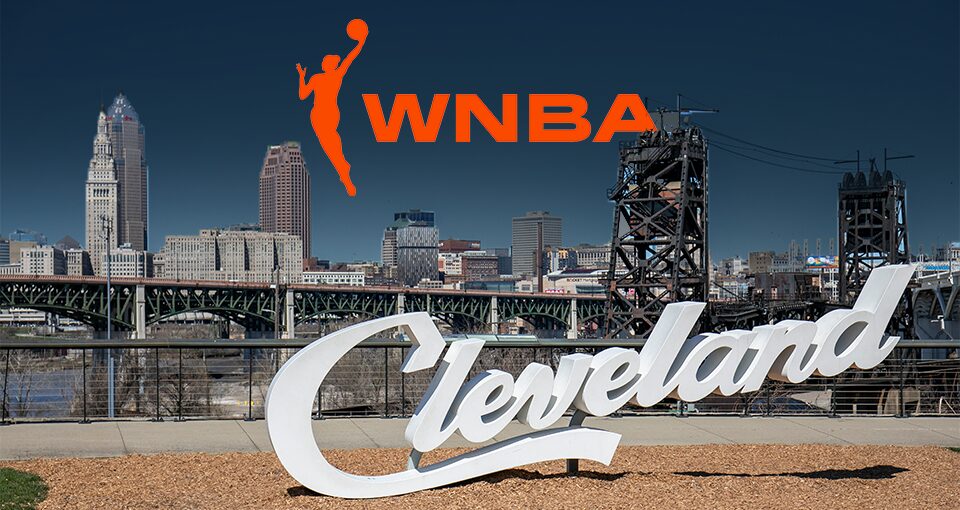
Cleveland just paid $250 million to get back into the WNBA, a fee that ties Detroit and Philadelphia for the largest in league history and doubles what Portland paid for its own expansion slot two years earlier. The real story isn’t whether Cleveland can support a basketball team. It’s whether a city that’s already turned Rocket Arena into a proven economic engine can pull off the same trick with a franchise built from scratch.
Watch What’s Trending Now!
Dan Gilbert’s Rock Entertainment Group is on the hook for that $250 million fee alone, likely closer to $300 million once facilities, infrastructure, and other buildout costs are factored in. Cleveland will be the first of three new expansion teams to tip off, starting in 2028, followed by Detroit in 2029 and Philadelphia in 2030.
The real economic bet is on Cleveland, not just the Sirens
Rocket Arena, already home to the Cavaliers and the Cleveland Monsters, is a proven draw for downtown Cleveland, regularly hosting major events that pull visitors into the surrounding district. That track record is the actual foundation of this bet: ownership isn’t just wagering on basketball, it’s wagering that the same venue and infrastructure that already works for hockey, boxing, and concerts will work just as well for a new WNBA team.
That optimism deserves a counterweight. The original Cleveland Rockers folded in 2003 after owner Gordon Gund couldn’t find a buyer, undone by declining attendance and mounting financial losses in a league that was still finding its footing. The Sirens are betting that today’s WNBA, and today’s Rocket Arena, are different enough from that era to avoid repeating it.
The Sirens have already attracted fan interest
The early demand suggests the market is buying in. The Sirens have collected roughly 9,000 season-ticket deposits in the year since Cleveland’s return to the league was announced, well before the team plays a single game, and the branding reveal itself drew an enthusiastic response, including from former Rockers players invited to the unveiling. Grant Gilbert, Rock Entertainment Group’s vice president of business and basketball operations, framed the new identity as something built to grow with the franchise.
“We really wanted something that people could rally behind, a real character,” Gilbert said. “The potential of the name is endless.”
The team has also already locked in Progressive Insurance as its jersey-patch sponsor, a concrete, current revenue stream well ahead of the 2028 opener.
The Sirens could become a multiplier for Rock Entertainment Group
Rock Entertainment Group already runs the Cavaliers, the Cleveland Monsters, and the G League’s Cleveland Charge, giving it an existing commercial infrastructure, sponsorships, ticketing systems, hospitality partnerships, that the Sirens can plug into rather than build from scratch. Sirens President of Business Operations Allison Howard has said the response to the branding reveal exceeded expectations, a sign the organization believes it can extend its existing sports business playbook into a fourth franchise without starting from zero.
The merchandise opportunity starts before the first tip-off
Being a brand-new franchise gives the Sirens a distinct advantage: fans can start supporting the team from day one, buying jerseys, hats, and gear before a single regular-season game has been played. That kind of early-adopter enthusiasm has helped other recent expansion teams build momentum well ahead of their debuts, and Cleveland’s ownership group is counting on the same dynamic here, treating the current wait until 2028 as a runway for building loyalty rather than dead time.
The hospitality economy could be one of Cleveland’s biggest winners
Rocket Arena and the surrounding Gateway Sports and Entertainment Complex, which also includes Progressive Field, have anchored real development in downtown Cleveland for decades, drawing millions of visitors a year to nearby restaurants, bars, hotels, and transportation services.
Sirens games figure to add another steady draw to that same footprint, and the upside grows further if the team pulls fans in from outside Northeast Ohio, exactly the kind of spillover effect that made the original arena investment worthwhile in the first place.
The comparison people miss
The Rockers and the Sirens are entering the WNBA at almost opposite moments in the league’s history. The Rockers played in a league still trying to prove women’s professional basketball could sustain itself, peaking at roughly 10,000 fans a game before attendance slid and the team folded, all without the kind of national television money or expansion-fee structure that exists today. The WNBA now averages well over 11,000 fans a game, is coming off a media rights deal reportedly worth billions of dollars across multiple networks, and just posted its first profitable season in the league’s 30-year history.
| Category | Cleveland Rockers | Cleveland Sirens |
|---|---|---|
| WNBA era | Played 1997–2003 | Will start in 2028 |
| Cleveland attendance | Averaged 10,350 fans at their peak in 1998 which declined to 7,400 per game in 2003 | Already have 11,000 ticket deposits before playing a game |
| Franchise investment | No proper investment | $250 million expansion fee |
| Media business | In 2007, the WNBA signed a contract extension with ESPN, the first agreement to pay TV rights fees to a women’s professional league. | $2.2 billion, 11-year media deal announced for 2026–36; with Disney, NBCUniversal, and Amazon, which later grew to about $3.1 billion after USA Network, Paramount (CBS), and Scripps (Ion). |
| League expansion | WNBA launched with 8 teams in 1997 | Cleveland becomes the 16th franchise in 2028 |
| Business outcome | Rockers folded after 2003 amid declining attendance and financial losses | Sirens enter while the league is expanding and commanding record expansion fees |
That gap is the real difference between the two eras, not the market itself, but the financial scaffolding underneath it. The Sirens are entering with a $250 million buy-in precisely because ownership believes that scaffolding is solid enough to support it, a bet the original Rockers never had the chance to make.
The next real test comes in 2028, when the Sirens finally take the court, with an expansion draft, roster construction, and free agency all still ahead before Cleveland’s wager gets its first real return.
Stud Budz and the rise of authenticity as a product
Top players can attract fans well outside the arena too, and the StudBudz are proof of exactly how far that reach can go. Former Minnesota Lynx teammates Natisha Hiedeman, now with the Seattle Storm, and Courtney Williams drew more than 7,000 viewers within minutes of launching their latest 72-hour Twitch stream from Chicago ahead of this year’s WNBA All-Star Game.
“We about to tear Chicago up,” Hiedeman said as the stream opened.
What started in Indianapolis in 2025 as a casual, behind-the-scenes broadcast turned into one of the league’s biggest off-court stories almost by accident. Fans got unscripted moments no traditional broadcast would ever capture, including viral clips of Lynx coach Cheryl Reeve and WNBA commissioner Cathy Engelbert dancing, the kind of access that turned two players into a genuine media phenomenon in a matter of days. Their Twitch channel climbed toward 60,000 followers during that original run, and the pair landed sponsorship deals with DoorDash and TOGETHXR off the strength of it.
The platform has meant more to Hiedeman and Williams than exposure, too. They’ve used it to spotlight masculine-presenting queer players in the league, a part of the WNBA that rarely gets this kind of visibility.
“To use our platform and StudBudz and what we do, just be ourselves and show everybody we’re gettin it poppin right now,” Hiedeman told Front Office Sports. “Everybody deserves opportunity, no matter what you look like, where you come from.”
By this year’s return to the concept, AT&T signed on as the stream’s first official sponsor, and Hiedeman and Williams traded their signature pink hair for blue to represent the brand. Even outside the WNBA’s usual audience, the crossover appeal has been hard to miss. Barstool’s Dave Portnoy, watching the original stream unfold, put it bluntly at the time: “StudBudz has done more marketing for the WNBA with their 72 hour stream than the bozos running the league have done since its inception.”
That’s exactly the kind of organic reach a $250 million franchise can’t simply buy on day one. The Sirens won’t have their own roster, let alone their own breakout personalities, until 2028, but the StudBudz model shows there’s a second, cheaper way for a new franchise to build a following long before opening night: give players room to be themselves, and let fans do the marketing from there.