
A week ago, KTRH News shared a surprising finding on social media. Only 32% of Americans consider social media influencing a legitimate career. But the numbers look different when you consider how much top celebrities can earn from a single post. Lionel Messi’s estimated value per Instagram post, for instance, is listed at $10.4 million in PlayersTime’s 2026 dataset, compared with $5.27 million for Zendaya. The figures raise an interesting question about how brands value sports stars and Hollywood celebrities.
Watch What’s Trending Now!
Instagram has become a major platform for influencer marketing. One market research estimate puts its share at about 29% of influencer marketing revenue, or roughly $9.09 billion, making it the largest platform by revenue share, although estimates vary by source. Sports, entertainment, and fashion are among its most prominent categories. PlayersTime’s data offers another way to look at the market, ranking accounts by their estimated sponsored-post value. Let’s take a closer look at the numbers and how they compare across sports and Hollywood.
The sports stars outpace Hollywood celebrities
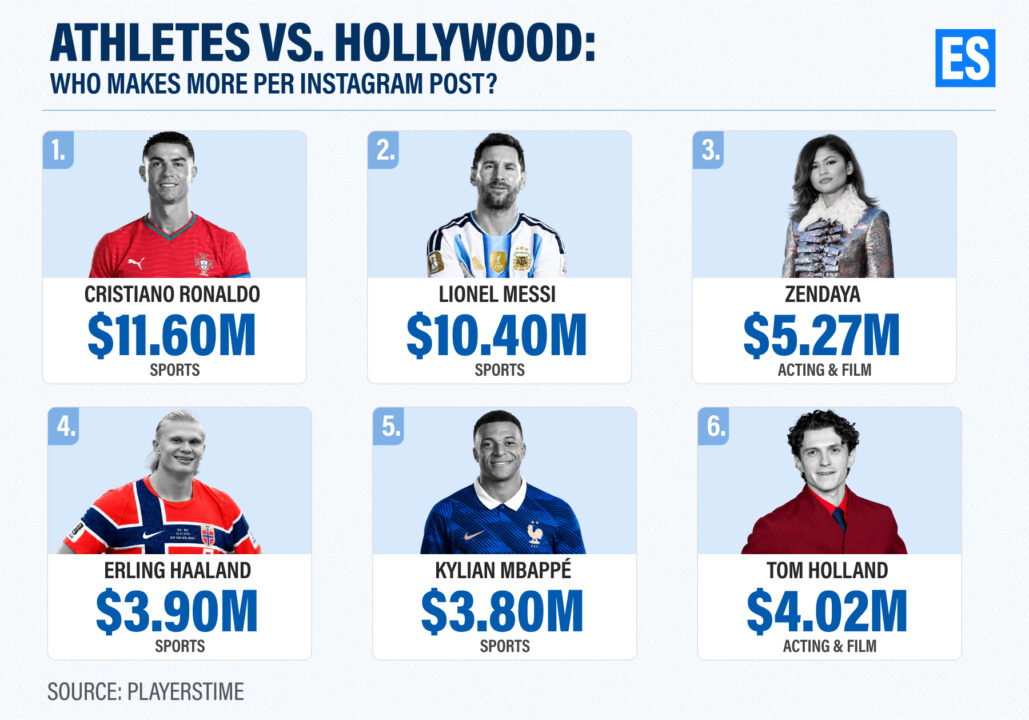
| Account | Category | Followers | Engagement rate | Estimated value per post |
| Cristiano Ronaldo | Sports | 679.7M | 1.71% | $11.60M |
| Lionel Messi | Sports | 517.1M | 2.01% | $10.40M |
| Zendaya | Acting & Film | 178.6M | 2.96% | $5.27M |
| Tom Holland | Acting & Film | 68.6M | 5.89% | $4.02M |
| Erling Haaland | Sports | 77.2M | 5.10% | $3.90M |
| Kylian Mbappé | Sports | 136.9M | 2.83% | $3.80M |
The table uses PlayersTime’s 2026 dataset. Follower counts and estimates are as of August 26, 2026. These are modeled estimates, not confirmed commercial rates.
Here are the key takeaways:
- Ronaldo’s estimated $11.60 million per post is about 2.2 times Zendaya’s $5.27 million. Messi’s $10.40 million estimate is nearly twice hers.
- Tom Holland’s $4.02 million estimate is slightly higher than Erling Haaland’s $3.90 million and Kylian Mbappé’s $3.80 million. Not every athlete has a higher estimated value than every actor.
- Sports accounts make up 18.9% of the study’s 800 accounts, but they hold eight of the top 20 spots. Six of those eight accounts belong to soccer players.
- Soccer is not the only sport represented near the top. Indian cricket stars MS Dhoni, at $9.41 million, and Virat Kohli, at $7.17 million, rank fourth and sixth, respectively.
- Zendaya is the highest-ranked American in the dataset but falls outside the global top five.
The numbers do not mean athletes are always worth more than actors. They do, however, raise a bigger question: why do some of the world’s biggest sports stars have higher estimated sponsored-post values than major Hollywood celebrities?
Sports still have the edge based on average estimated value per post
| Category | Average estimated value per post |
| Sports | $603,576 |
| Entertainment & Music | $397,249 |
| Acting & Film | $393,052 |
| Fashion & Beauty | $173,646 |
The study also puts sports ahead of the other categories in average estimated value per post.
- Sports averages $603,576 per post, about 52% more than Entertainment & Music and 54% more than Acting & Film.
- The study includes 151 sports accounts, compared with 265 in Entertainment & Music and 98 in Acting & Film.
- A small number of superstars push up the sports average. Ronaldo and Messi account for just two of the 151 sports accounts, or about 1.3% of the category.
- Together, their estimated post values total about $22 million. That represents roughly 24% of the category’s estimated $91 million total, based on the reported average and account count.
- Even without Ronaldo and Messi, the sports average would be about $464,000 per post. That is still roughly 17% higher than Entertainment & Music and 18% higher than Acting & Film.
Ronaldo and Messi have a major effect on the figures, but they are not the only reason sports ranks first.
The reasons behind the biggest soccer stars’ command
Ronaldo and Messi have built commercial profiles that extend well beyond their performances on the field.
Imago
Image Courtesy for Players & Hollywood Stars: Imago
- Cristiano Ronaldo ($11.60M): His Instagram account is a major platform for promoting his long-standing Nike partnership and CR7 brand. With nearly 680 million followers, he has the largest audience in the study.
- Lionel Messi ($10.40M): His commercial portfolio includes a long-term Adidas partnership reportedly worth about $25 million a year, along with luxury campaigns such as Louis Vuitton. His Instagram audience stands at around 517 million.
- Kylian Mbappé ($3.80M) and Erling Haaland ($3.90M): Both represent a younger generation of soccer stars. Their estimated values are well below Ronaldo’s and Messi’s, but their sporting success and growing audiences give them strong commercial potential.
Several factors may make elite soccer players attractive to advertisers:
- Global audiences: Major soccer leagues and international tournaments attract fans across countries and languages.
- Regular exposure: League games, international competitions, transfers, and award ceremonies keep players in the spotlight throughout the year.
- A strong brand identity: Speed, skill, and winning can make athletes appealing to sportswear, watch, automotive, and performance brands.
- Long-term appeal: Successful players can remain relevant across multiple seasons, clubs, and international tournaments.
However, the study does not measure actual campaign results. It also does not prove that these factors directly lead to higher endorsement fees.
How Hollywood has helped its stars
Zendaya’s estimated $5.27 million per post and Tom Holland’s $4.02 million show that actors can also command high modeled values. Their commercial appeal comes from different opportunities.
- Film and streaming releases can bring a sudden increase in public attention.
- Fashion and luxury partnerships connect celebrities with products that audiences aspire to own.
- Red carpets, interviews, and major cultural events keep actors in the public eye.
- Popular film franchises can help celebrities maintain their relevance long after a movie’s release.
- Acting & Film has an average estimated value of $393,052 per post, close to Entertainment & Music’s $397,249 but about 35% below sports.
Follower count alone does not explain these differences. Estimated value per follower offers another way to compare the accounts.
| Account | Estimated value per follower |
| Cristiano Ronaldo | $0.017 |
| Lionel Messi | $0.020 |
| Kylian Mbappé | $0.028 |
| Zendaya | $0.029 |
| Erling Haaland | $0.051 |
| Tom Holland | $0.059 |
The calculation divides each account’s estimated value per post by its follower count.
By this measure, Holland and Haaland have higher estimated values per follower than Ronaldo. Ronaldo’s total is much larger because his audience is far bigger.
This comparison does not prove that one industry is better than another. It shows that brands may value audiences differently depending on a celebrity’s reach, engagement, and commercial appeal.
Instagram is more than a place for sponsored posts
For major athletes, Instagram is part of a much larger business. Their accounts can promote existing sponsorships, new products, and personal brands.
- Ronaldo ($11.60M) and Messi ($10.40M): Their posts can give additional exposure to sponsorships and product launches. A single post may support a wider business relationship involving advertising, licensing, and other deals.
- Haaland ($3.90M) and Mbappé ($3.80M): Both are still building their commercial profiles. Brands may see their current popularity as an opportunity to reach even larger audiences in the future.
- A different path to the top: MS Dhoni has around 50 million followers and an engagement rate close to 19%. His estimated value of $9.41 million is close to Ronaldo’s and Messi’s, showing how strong audience engagement can affect these calculations.
The key question is whether brands are paying for a single Instagram post or for access to an athlete’s wider commercial appeal.
The study cannot answer that question. An estimated price for one post does not reveal the terms of a long-term sponsorship deal.
Does a $4 million Instagram post actually sell products?
A high estimated price suggests that an account could have significant commercial value. It does not prove that a sponsored post will generate sales or profit.
- The model is closely linked to likes: For the six accounts highlighted in the study, the estimated post values are within about 3% of their average likes. Ronaldo averages 11.41 million likes against an estimated value of $11.60 million, while Zendaya averages 5.25 million likes against $5.27 million. The figures suggest that the model assigns roughly $1 in estimated value per average like. However, likes do not necessarily lead to purchases.
- Estimated values can differ from reported rates: PlayersTime notes that Dhoni’s corporate endorsement rate has been reported at $250,000 to $500,000 per partnership. That is roughly 19 to 38 times lower than his modeled $9.41 million value. His relatively infrequent posting may be one factor behind the difference.
- More followers do not always mean a higher estimated value: Neymar has around 242 million followers but an engagement rate of just 0.78%. His estimated value is $1.90 million per post, below Haaland’s $3.90 million, even though Haaland has roughly one-third as many followers.
- Some celebrities are far above the category average: The average estimated value for sports accounts is $603,576 per post. Holland’s $4.02 million estimate is about 6.7 times that amount, while Ronaldo’s $11.60 million estimate is about 19 times higher.
Brands also have different goals when choosing influencers:
- Brand awareness: Reaching a large audience and making a brand more recognizable.
- Engagement: Encouraging people to like, comment on, and share sponsored content.
- Sales and conversions: Getting people to buy products, sign up for services, or visit a website.
- Brand image: Building a long-term connection with qualities such as performance, luxury, prestige, or cultural relevance.
A global superstar may be worth the cost of a campaign designed to reach millions of people worldwide. For a more targeted product, a smaller creator with a relevant and engaged audience could deliver better results.
Ultimately, PlayersTime’s figures estimate potential sponsored-post values, not confirmed earnings or returns for advertisers. The data offers a useful comparison of the commercial reach of athletes and actors, but it cannot show whether those posts lead to sales or justify the price brands might pay. That depends on the campaign, the audience, and what the advertiser is trying to achieve.