
Imago
Nike image courtesy: IMAGO
Imago
Nike image courtesy: IMAGO
“The results aren’t there yet,” said Nike’s CEO Elliott Hill. On paper, Nike reported $46.4 billion in revenue for fiscal year 2026. On paper that seems massive, so why is Hill cautious? It was 2% lower than the previous year after adjusting for currency changes. On top of it, its revenue for the fourth quarter also fell 1% to $11 billion. Even though Nike earned more than analysts expected (about $46.27 billion), the company’s stock still fell 3.4% after the earnings report. So, is the Oregon-HQ company really struggling internally?
Watch What’s Trending Now!
CEO Elliott Hill said Nike is improving through its “Win Now” plan. The company is working to build a stronger team, make better products, strengthen the Nike brand, and serve customers better. He said Nike’s renewed focus on sports is helping its performance business grow. One of the biggest success stories is Nike Running, which has recorded five straight quarters of double-digit sales growth and added about $1 billion to the business.
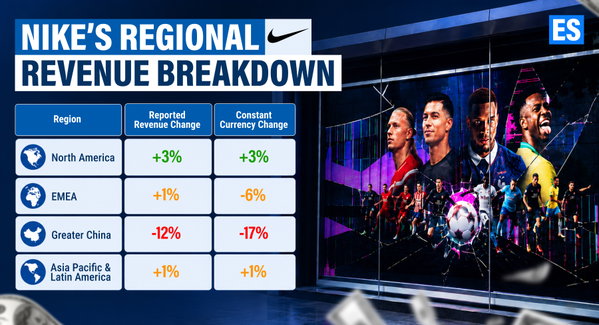
However, Hill also said Nike has not yet reached the level it wants and still has more work to do. Nike brand revenue was $10.7 billion, which is 3% less after currency adjustments. The decline mainly came from China, which fell 12%, and EMEA (Europe, the Middle East, and Africa), while North America recorded growth of 5%. Nike Direct sales also fell 8% because Nike Brand digital sales dropped 12% and sales at Nike-owned stores fell 7%.
Meanwhile, Converse had a difficult quarter, with revenue falling to $244 million, down 32% as sales declined in every region. However, it’s not like the entire year went flat. Nike Direct earned $4.1 billion, falling 7%. But Nike did see various positive outcomes, too.
- Nike’s wholesale business performed better. Fourth-quarter wholesale revenue reached $6.6 billion, increasing 4%. Plus, Nike’s gross profit margin improved to 49.2% in the fourth quarter. This was mainly because the company expected to recover money from IEEPA tariffs, which increased its profit.
- Nike also reported earnings of $0.72 per share, including a $0.52 per share benefit from the expected tariff recovery. These are still better results after the damage done in the previous few years.
- The earlier strategy of selling more products through its own stores and website did not work as expected. Many customers never ditched the regular retail stores, and because of that, products from competitor brands got more space on the shelves.
That’s when Elliott Hill returned as Nike’s CEO in October 2024 to focus on retail stores again. However, despite all the efforts, China still remains Nike’s weakest link.
China is structural, not cyclical
Nike has now reported six straight quarters of lower sales in China. Nike also expects sales in China to keep falling slightly over the next nine months, which means there is no scope for a quick recovery. Back in March, Hill himself acknowledged China has “the longest road ahead” among the priority regions.
- One major reason is that many younger Chinese shoppers now prefer local sports brands like ANTA and Li-Ning instead of Nike.
- This change started before the U.S.-China trade tensions, so it is not only because of that.
- Nike CFO Matthew Friend said the company expects sales in China to stay weak for now. Nike is also working with retail partners to clear extra inventory before bringing in new products.
Greater China makes up about 15% of Nike’s yearly revenue and is the company’s third-largest market after North America and Europe, the Middle East, and Africa (EMEA). Despite these problems, Nike said it is seeing some early signs of improvement through the FIFA World Cup 2026, in which they were the jersey makers for 12 teams.
Even though Nike was not an official FIFA sponsor, its World Cup advertisements became very popular on social media. In some measures, Nike’s ads reached and engaged more people online than Adidas’ ads, even though Adidas was the tournament’s official sponsor.
But all that can overpower the fact that with China, Nike Direct is seeing a major fall, too.
Nike Direct & Basketball is still underperforming
- Nike Direct (sales through Nike’s own stores and website) made $17.7 billion in the full year, down 6% from the previous year. In the fourth quarter, Nike Direct sales were $4.1 billion, down 7%.
- Nike’s online business also became weaker. Sales of the Nike brand’s digital fell 12% during the full year. This was one of the main reasons Nike Direct sales declined.
- On the other hand, Nike’s modern-day NBA stars are not as commercially successful as Michael Jordan, Kobe Bryant, or LeBron James were at their peak. That makes it harder for Nike to sell basketball products.
- Nike signed Caitlin Clark in 2024, but her first signature shoe will not arrive until October 2026. Nike waited too long to launch its own shoes.
UBS analysts think Nike may have a harder time growing its business quickly under CEO Elliott Hill than many people expected. For many years, basketball was one of Nike’s biggest strengths. Popular NBA stars helped Nike sell millions of shoes and clothing. However, in April, UBS said basketball is no longer as strong for Nike as it used to be.
- Nike is now selling more products through retail partners (wholesale) instead of relying mainly on its own stores and website. This helps the brand reach more customers and rebuild relationships with retailers.
- However, wholesale sales usually make less profit on each product than direct sales. So, while this strategy is better for Nike’s long-term growth, the company has to accept lower profit margins for now as it shifts more sales back to retail partners.
- Jalen Brunson won the NBA Finals MVP wearing Nike’s Kobe Bryant shoes. To date, this remains Nike’s biggest basketball success story. But nothing related to a current NBA star made such hype.
- NBA star Anthony Edwards has signed with Adidas instead of Nike. That gives a major rival one of basketball’s biggest future faces. Air Jordan Brand’s revenue fell 3% to $7 billion. After adjusting for currency changes, sales were down 5%.
However, not everything is going downhill.
The Bright Spots
North America was Nike’s strongest market in fiscal 2026, as it saw a 5% growth for the full year. With that, the wholesale business also rose to 4% in the fourth quarter and 6% for the full year.
Plus, Nike moved about 8,000 employees into teams based on different sports, such as running, basketball, and football, instead of organizing them by men’s or women’s products. Best part? Because of this, Nike’s running business has grown by more than 20% for three straight quarters. Popular shoes like the Pegasus Premium, Vomero 18, and Alphafly 3 helped Nike attract runners who had started buying shoes from rivals like Hoka and On Running.
Nike’s fourth-quarter profit also got a big boost from $986 million in tariff refunds under the IEEPA program. Because of that one-time benefit, the company’s gross profit margin increased to 49.2%. Without the tariff refund, the margin would have been about 40.3%.
CEO Elliott Hill said Nike does not expect business to improve quickly, and the first quarter of fiscal 2027 might not see quick results. But there’s scope for improvement later, as three things can save their fate, which investors are also looking at.
- First, they want to see sales in China stop falling after several weak quarters.
- Second, they want to see Caitlin Clark’s first signature Nike shoe, which is expected to launch in October, become a strong seller.
- Third, they want Nike’s basketball business to improve the way its running business has. Nike needs a new signature basketball shoe that becomes popular with customers instead of relying on players wearing older models like Kobe Bryant’s Nike shoes.
To make sure these things happen smoothly, Nike is also making leadership changes. The company’s chief financial officer, Matt Friend, will leave in August, and David Denton will be joining from Pfizer. Friend helped build Nike’s direct-to-consumer strategy. With Nike now shifting back toward wholesale, investors will be watching how Denton reshapes the company’s financial strategy.
Another important event is Nike’s Investor Day in the fall, where Hill will give investors a detailed plan for the company’s long-term future and full-year financial outlook. The World Cup schedule also matters for sales as the Round of 16 matches will happen, quarterfinals will begin on July 9, and the final will be held on July 19 at MetLife Stadium.
Nike’s next few weeks are very important. The company will report its first-quarter fiscal 2027 results in September. Investors will be looking closely to see whether the World Cup excitement helped increase sales or if Nike takes another major hit.
Written by

Edited by

Parnab Bhattacharya