
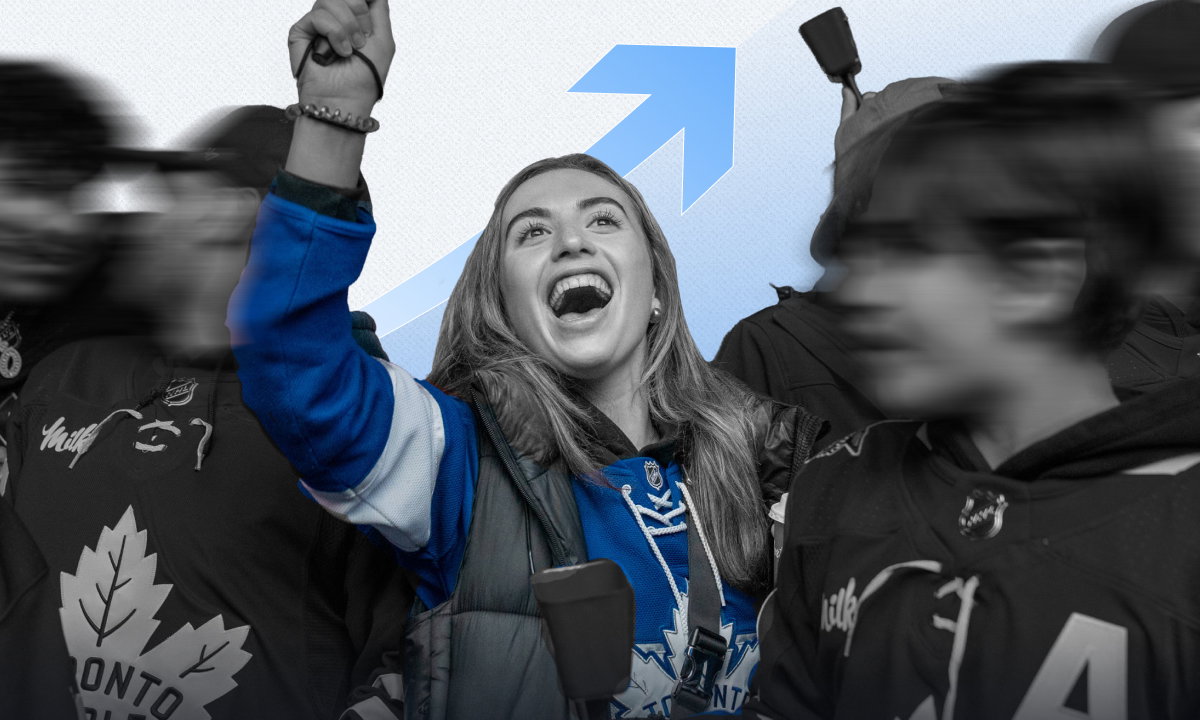
Hockey, as a sport, has mainly attracted men for years, but the 2026 NHL Stanley Cup Playoffs tell a different story. Women also tuned into the game. But the sport is not new to them, given that the world has long had outstanding female hockey players like Hilary Knight of the United States and Marie-Philip Poulin of Canada. So, why now?
Watch What’s Trending Now!
The reason is that several young women are following the NHL, and those numbers are outstanding.
Although this year’s first two rounds of the NHL Stanley Cup Playoffs became the most-watched in U.S. history, what people really focused on was the substantial increase in female viewers: TNT Sports reported a 66% surge, and ESPN reported an even bigger 106% jump. Many of these new viewers are young adults between the ages of 18 and 34.
Because of this, the playoffs are averaging 1.4 million viewers per game, which is 63% higher than last year and 24% higher than 2024’s record. But this surge in popularity did not happen overnight. The success of last year’s 4 Nations Face-Off tournament created the hype. Then the Winter Olympics in Milan Cortina during February gave hockey another major boost after both the U.S. men’s and women’s teams won gold medals.
NHL chief operating officer Stephen McArdle explained the surge:
“The Olympics were a cultural moment. We know that Olympic viewership does appeal to those demographics, to that female demographic, and so I think the Olympic bump that we saw was really in part influenced by that female Olympic audience.”
Women emerge as NHL’s fastest-growing audience segment
The growth in female viewership has less to do with the NHL’s popularity. For years, the league struggled to expand its female viewership, and ESPN VP of Production Linda Schulz knows why.
“We see the numbers up everywhere,” she explained. “(Hockey) is a particular challenge because sports fans tend to follow something that they themselves have participated in, and hockey is one that is not as commonplace for people to have actually strapped on skates. I approach it with, if I get a new fan coming to hockey, what is going to keep them?”
Sports analyst Darin W. White’s 2016 research showed that the number of female fans had increased significantly for most sports, except hockey. The 2015 data provided percentages for all sports, with the NFL showing the highest percentage of female viewers at 45.8% and the NHL the lowest at 36.6%.
But a Reddit user’s post in 2022 said otherwise: “[Greg Wyshynski] NHL says its U.S. female fanbase grew faster than any other league (+4.9 million, an increase of 30%, per Scarborough Research) from 2009-2021. Four out of 10 U.S. NHL fans are female. NHL’s female cable TV viewership (ESPN/TNT) in the U.S. rose 61% last regular season.”
These numbers prove that women have always been interested in hockey. However, the success didn’t come overnight.
Young stars, global events, and social media spark hockey boom
NHL chief operating officer Stephen McArdle said social media, especially TikTok, has played a big role in bringing new fans to hockey. More women than men watch the league’s famous TikTok videos. One video that went viral among female fans was Carolina Hurricanes player Jordan Martinook losing a skate blade during a game. The fun part of the video attracted many female audience members and increased their interest in the sport.
The NHL has used social media to put hockey in front of younger audiences, helping attract both male and female fans. The league and its broadcast partners have also promoted games across major platforms such as ESPN, ABC, TNT, TruTV, and HBO Max. As a result, more people are discovering the sport online and then tuning in to watch games live, helping hockey reach new audiences and grow its fan base.
And let’s not forget the hockey-themed romcoms that are making a buzz among youth. The fast-paced action on the ice and the viral success of shows like Heated Rivalry and Off Campus have also drawn fans in.
“We know that the fictional series are a gateway to our sport,” McArdle said. “We know that it opens doors to an interest in the sport of hockey, and it’s incumbent upon us to make sure that new audiences that are coming through those doors feel welcomed as they come in, and also that we help them find their way through the door.”
But expanding the reach beyond the traditional fan base was a tough task. And the NHL handled that, too.
How the NHL expanded beyond its traditional fan base
Before 2021, NBC had the exclusive rights to show NHL games in the United States. So, the NHL broadcasts were only available through NBC’s television networks. But in March 2021, ESPN agreed to a new seven-year broadcasting deal with the NHL, starting from the 2021-22 season.
The agreement gave ESPN the rights to broadcast four Stanley Cup Finals between 2022 and 2028. It also gave Disney streaming rights. So, this way, the league made hockey easier to watch for people who prefer streaming instead of traditional television. However, the deal was not exclusive. Unlike NBC’s previous contract, ESPN could share NHL broadcasting rights with others.
All this strategy helped them secure a major audience and turn them into NHL fans. Even TNT Sports executive VP and chief content officer explained their main aim behind it.
“That’s why it’s so important to meet them where they are,” Craig Barry said. “That’s why our kind of strategy is to put it everywhere in a simulcast capacity, so regardless of where you are consuming and digesting your content, in this particular case, NHL games, it’s there for you.”
Linda Schulz said modern camera technology also helped make watching hockey a lot easier for fans. For example, aerial sky cameras give viewers a better view of the entire rink, making it easier to see how fast the players are moving and how physical the game is. This helps people understand the action, especially those new to hockey.
This sudden rise might shock many, but it’s the NHL’s strategic planning of using its games’ social media and broadcasting rights to give the game better exposure. The league values all its fans and wants to grow engagement. In today’s era, that’s a tough task because the audience has a shorter span and often loses interest.
But by meeting Gen Z on TikTok and through sports romcoms, the NHL quietly built a new fanbase. The playoff numbers prove it worked.