
Major League Baseball’s local broadcasting business is going through a major change. The collapse of regional sports networks (RSNs) and the decline of cable TV have forced the league to take over local broadcasts for more teams. Now, Commissioner Rob Manfred wants to take the next step by bringing local media rights under MLB’s control and selling them as one package when the next media rights cycle begins in 2028.
Watch What’s Trending Now!
Now, the challenge is whether MLB can stabilize revenue without widening the gap between large and small markets.
Why Local TV Still Matters to MLB
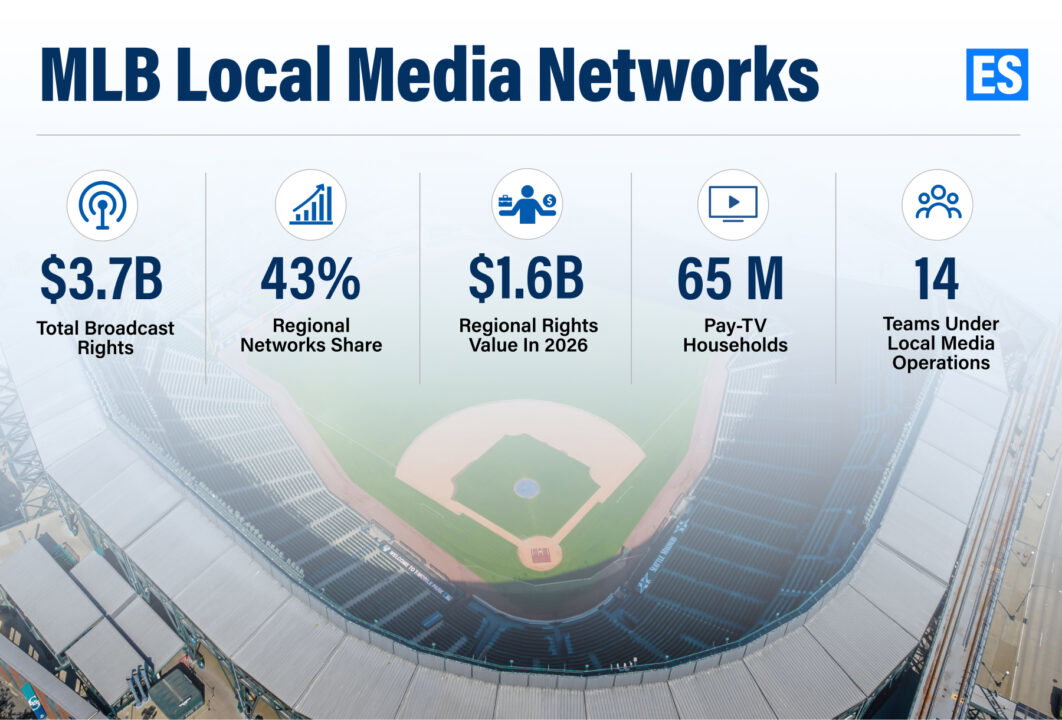
According to Ampere Analysis, MLB’s regional broadcast rights are worth about $1.6 billion in 2026. That represents 43% of the league’s total broadcast rights revenue of $3.7 billion. National media deals account for the remaining $2.1 billion.
Local TV has always been especially important to baseball. Each team plays 162 regular-season games, and most of those games are broadcast in the team’s home market. According to the Wall Street Journal, clubs have traditionally earned 20% to 25% of their total revenue from local media, a larger share than teams in any other major U.S. league.
Data from Sportico, cited by the newsletter State of the Screens, puts local TV’s share of total revenue at about 23% for MLB. For comparison, the figures are 13% for the NBA, 12% for the NHL, and just 1% for the NFL.
The problem is that this business depends heavily on cable TV, and the number of cable subscribers continues to fall.
- Ampere estimates that U.S. pay-TV households dropped from 96 million in 2016 to about 65 million by the end of 2026.
- Streaming households are expected to grow from 57 million to 112 million over the same period.
- By 2031, Ampere expects pay-TV households to fall further to 58 million, while streaming households could reach 120 million.
National media deals are negotiated by MLB and their revenue is shared equally among teams. Local deals, however, are negotiated by individual clubs. This has created major differences in how much each team earns.
The Teams Feeling the Impact of the RSN Collapse
The regional sports network business began falling apart in stages. Diamond Sports Group, which owned the Bally Sports networks, filed for Chapter 11 bankruptcy in March 2023. It later emerged as Main Street Sports Group, and its channels were renamed FanDuel Sports Network.
Imago
MLB Stadium Image: IMAGO
However, Main Street reportedly lost around $200 million in 2025 and missed payments to several teams. Its networks began shutting down in 2026.
Over the past four years, 13 of MLB’s 30 teams have lost their RSN partners. According to Ampere, 12 of those teams were affected by the Diamond and Main Street bankruptcies.
MLB first stepped in to produce local broadcasts for the San Diego Padres in 2023 after Diamond missed a payment. The Arizona Diamondbacks followed. In early 2026, nine teams ended their contracts with Main Street, and most moved to MLB’s broadcasting service.
For the 2026 season, MLB produces and distributes local games for 14 teams: the Brewers, Cardinals, Diamondbacks, Guardians, Mariners, Marlins, Nationals, Padres, Rays, Reds, Rockies, Royals, Tigers and Twins.
However, there is a major difference between the old and new systems. RSNs guaranteed teams fixed rights payments. Under MLB’s model, revenue depends on subscriptions, advertising and fees from cable and other distributors. That means teams no longer have guaranteed payments. Manfred has said local media revenue is “down significantly” this year.
Case Study: The St. Louis Cardinals
The St. Louis Cardinals show how much local broadcasting revenue can fall.
According to reporting by Cardinals beat writer Josh Jacobs, the team expected to earn about $20 million from local TV in 2026. That is a major drop from the roughly $60 million it received under Main Street in 2025. The team reportedly earned $75 million from Bally Sports in 2024.
Some reports have put the Cardinals’ expected 2026 revenue closer to $40 million. The exact figure has not been confirmed, but either estimate points to a significant decline.
What It Means for Smaller Markets
Smaller-market teams have fewer ways to make up for lost local TV revenue.
Ampere estimates that the 14 teams now covered by MLB’s broadcasting service account for about 30% of regional TV revenue, excluding advertising. These teams previously had more valuable RSN deals, but many have seen those arrangements disappear.
Most of the teams that still have regional broadcasting deals, particularly those in larger markets, continue to earn more. This has increased the financial gap between clubs. For now, MLB’s broadcasting service is an interim solution to the problem.
Is MLB’s New Model Working?
MLB Local Media started in 2023 as a response to the RSN crisis. It has since grown into a full broadcasting operation covering 14 teams.
The league handles production and distribution, making games available through in-market streaming subscriptions as well as cable, satellite, and telecommunications providers.
Here’s how the service works for fans:
- In-market streaming subscriptions cost $99.99 per season or $19.99 per month for the 14 teams without RSN deals.
- Fans can combine a team’s local streaming package with an MLB.TV out-of-market subscription for $199.99 per season or $39.99 per month.
- The service removes local blackouts for these teams.
- Under its 2026-2028 agreement, ESPN holds in-market streaming rights for local broadcasts produced by MLB. ESPN has also said it plans to add in-market games to its app in 2027.
Early audience numbers suggest the service is helping teams reach more viewers. One report found that the 14 teams under MLB’s in-market service saw their audiences increase by about 8% this season. The Angels also recorded a 196% jump in Opening Day viewership after taking control of their broadcasts.
There have also been claims that 11 of the 14 teams recorded double-digit audience growth. However, that figure could not be independently confirmed and should be treated with caution.
The new model has clear benefits. More fans can watch games, and local blackouts are no longer an issue for the teams covered by the service. But the financial side remains uncertain. Subscription fees, advertising, and distribution payments have not replaced the guaranteed rights fees that RSNs once provided.
In short, more people may be watching, but teams have less certainty about how much money they will earn.
The 2028 Plan: Selling Local Rights Together
Manfred has been discussing a centralized local media strategy since at least 2024, with 2028 as the target. That year is important because it marks the final season of MLB’s current national media deals. By then, the local rights of almost all teams are expected to become available.
According to Ampere, MLB could bring the rights together and sell local games as one package to a streaming platform, potentially making them available nationwide.
This approach could offer several benefits:
- More attractive to streaming platforms: One package would give streaming companies access to a large number of games from one of the four major U.S. sports leagues.
- More financial stability for smaller teams: Sharing revenue could help clubs that have lost valuable RSN deals.
- Fewer blackouts: A single platform could make it easier for fans to find and watch games.
- A possible role for ESPN: ESPN already has in-market streaming rights for MLB-produced local broadcasts, making it a potential partner as the league develops its next model.
Manfred has also made it clear that MLB is open to different arrangements. He has said the league does not necessarily need the local rights of all 30 teams “wall-to-wall.” He has also indicated that local media rights will not be centralized through a standalone deal and that other changes may be needed as part of the plan.
Can Centralization Fix Baseball’s Financial Divide?
The financial gap between MLB teams is already significant. Ampere estimates that the Dodgers and Yankees alone account for 23% of all MLB regional rights fees.
Their local media deals are worth more than the entire payrolls of many smaller-market teams. That gives large-market clubs a strong reason to oppose a system that would require them to share more of their local broadcasting revenue.
The issue is also likely to become part of MLB’s labor negotiations. The collective bargaining agreement between the league and the players’ union expires at the end of 2026, and a lockout is widely expected.
According to The Athletic, MLB’s proposed salary cap plan would treat all local media revenue as central revenue and distribute it equally among the 30 teams. Under the current system, each club contributes 48% of its local media revenue to the central pool and keeps the remaining 52%.
Here’s how the two systems would compare:
| Today | Proposed centralized model | |
| Local rights sold by | Each club or RSN | MLB, collectively |
| Guaranteed fees | Varies; falling | Potentially pooled |
| Revenue sharing | 48% of local revenue to the central pool | All local revenue is treated as central. |
| Blackouts | Common | Potentially eliminated |
| Biggest winners | Dodgers, Yankees, large markets | Smaller-market clubs |
Stabilize the Business or Shift the Burden?
Centralizing local media rights could give teams more predictable revenue, especially those hit hardest by the RSN collapse. However, it would not automatically bring in more money.
Large-market teams would have to give up some of their financial advantage. Players are also likely to question any proposal connected to a salary cap. At the same time, MLB would need to convince streaming companies that a combined package is valuable enough to replace the money teams once received from RSNs.
If the new deal does not bring in enough revenue, the financial pressure could simply shift from individual teams to the league’s shared pool.
MLB’s regional media rights are still worth about $1.6 billion, but the cable business that supported them is shrinking. The league’s current model has made games easier to watch and reduced blackouts, but it has not restored the guaranteed income teams once received.
Whether MLB can build a more profitable and balanced system by 2028 will depend on three things: how much streaming companies are willing to pay for a combined package, whether large-market teams agree to share more revenue, and how the upcoming labor negotiations unfold.