
Imago
Golden Tempo Image Courtesy: IMAGO
Imago
Golden Tempo Image Courtesy: IMAGO
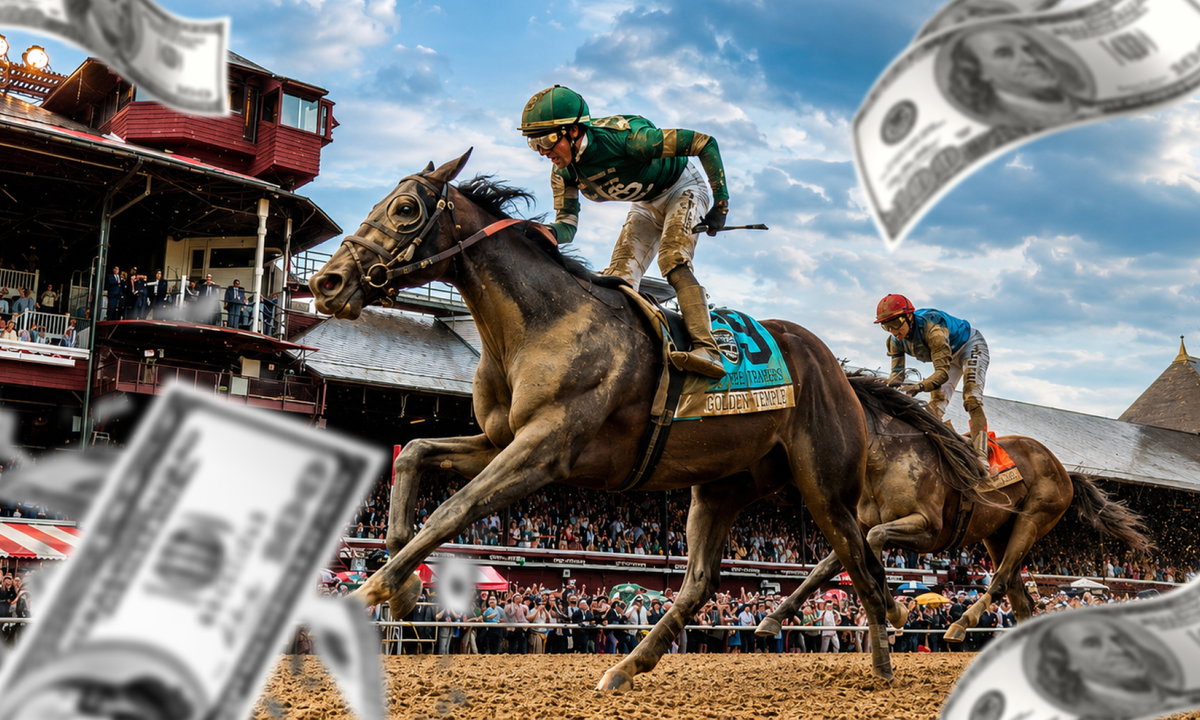
Nobody had expected a horse to ignite this much controversy. Golden Tempo won the 158th Belmont Stakes at Saratoga Race Course in New York on June 6th, 2026, capping a remarkable run that began with an upset victory at the Kentucky Derby. The win made Golden Tempo the 13th horse in history to claim both the Derby and the Belmont. It also cemented trainer Cherie DeVaux as the first woman to train a Kentucky Derby winner and only the second to train a Belmont Stakes winner, joining Jena Antonucci, who did it in 2023. . But the celebration didn’t last long before the second-guessing started.
Watch What’s Trending Now!
Golden Tempo’s road to Saratoga began at Churchill Downs, where the horse went off at 23-1 odds. To everyone’s awe, Golden Tempo stunned the field to win the Kentucky Derby in 2 minutes and 2.26 seconds. It was one of the greatest upsets in recent Derby history.
The Preakness Stakes, which is the second leg of the Triple Crown, was on the horizon just two weeks later. But DeVaux and the ownership group chose to skip it entirely, as their target was the Belmont. And fairly so, it paid off. Golden Tempo entered the 1 1/4th-mile Belmont as the 9-2 second choice against a nine-horse field. But it was yet another easy win for Golden Tempo in 2:03:49.
All of these triggered a larger debate—whether to aim for the triple crown or to prioritize the horse’s health?
Fans were hoping to get a Triple Crown winner this year, but Golden Tempo skipping shattered all hopes. The hurt was very real. Despite the Belmont Stakes win, fans can’t stop criticizing the move.
On June 7th, 2026, Kentucky Derby posted on X about the win, saying, “Kentucky Derby winner Golden Tempo wins the 158th Belmont Stakes with Jose Ortiz aboard for Cherie DeVaux, claiming the final leg of the Triple Crown. They did it.”
Kentucky Derby winner Golden Tempo wins the 158th Belmont Stakes with Jose Ortiz aboard for Cherie DeVaux, claiming the final leg of the Triple Crown.
They did it. pic.twitter.com/LvmXRRKyJG
— Kentucky Derby (@KentuckyDerby) June 6, 2026
One X user expressed their frustration over trainers skipping the Preakness Stakes and said, “The owners and the trainers had the opportunity to run the horse in the Preakness. They made a big mistake. They should’ve let that horse run, but even though he can come from behind, he’s no Secretariat. ❤️🔥❤️🔥❤️🔥❤️🔥”
But is everything about the title?
The horse is not a machine, DeVaux’s decision was rational
After the Derby victory, Golden Tempo’s trainer, Cherie DeVaux, made it clear that the horse would not run in the Preakness. The main reason behind this move was the packed schedule, as all three legs were closely together within five weeks.
All DeVaux wanted was to give her horse some rest before the Belmont Stakes. And Golden Tempo is not the only one that skipped the Preakness. Sovereignty’s trainer, Bill Mott, did the same last year after winning at Churchill Downs.
But fans couldn’t stop talking about it. Breaking a year-old tradition deeply hurt fans’ emotions, as one Reddit user said, “It’s a shame that winning the Triple Crown is going by the wayside. It’s a shame for fans of the sport. And for those like myself that live for the excitement & tradition of it.”
But despite the backlash, DeVaux was firm in her stand, as running horses in just two weeks didn’t make sense to her. Plus, the concern for their longevity also increased.
“I understand that fans of the sport or fans of the Triple Crown are disappointed, but the horse is not a machine.” DeVaux said to Fox News Digital, “I have to advocate as the trainer to the owners or the clients, and we had a conversation; it wasn’t my decision. It was a decision we made as a group, and I’m sorry if people don’t understand what goes into it.”
On top of it, she stood by her words even after winning the Belmont Stakes, as she made it clear that backing out of the Preakness was the right move.
“I do think we made the right decision. I don’t think we would have the same horse if we had run back in two weeks,” DeVaux added.
Even Brad Cox, who won the 2021 Derby, supported DeVaux.
“I’m all for moving [the Preakness],” Brad Cox said to Sports Illustrated’s Pat Forde. “I get history, and I’m a big fan of history, but I think the health and welfare of the horse come first before tradition. You’ve got to get some longevity out of them. Running them back in two weeks is not necessarily going to help their longevity.”
Horses like Golden Tempo are a valuable asset for owners, and they don’t want to injure them and lose their chance to compete after all. Owning and racing a top horse costs a lot, and if they lose their longevity, it will be a major financial loss for the owners.
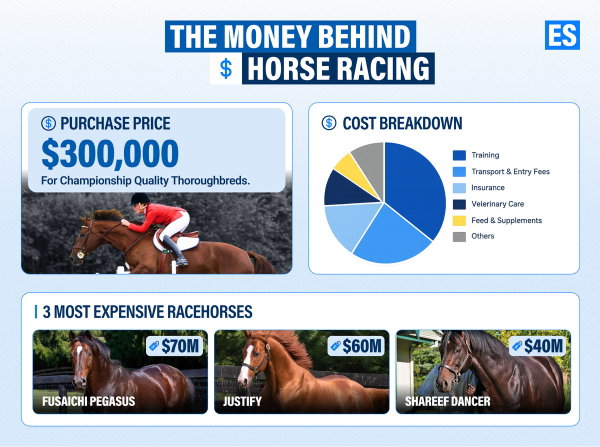
Young horses with solid bloodlines often go for $10,000 to $50,000. One example of that is American Pharaoh, whose value reached $60 million. Then training them is also a big financial commitment. A maiden horse typically costs between $2,500 and $3,500 per month to train. While horses who are already racing can cost $5,000 to $6,000 monthly. Stakes-level horses require $8,000 to $10,000 per month.
Then the costing doesn’t stop at that; owners also require paying boarding fees that range from $500 to $2,000 monthly. It depends on where the horse is staying, either at a training facility or a private farm. Trainers usually get 10% to 30% of a horse’s earnings, while jockeys usually earn around 5% to 10%.
Imago
Image of Golden Tempo: IMAGO
Then come the entry fees that include transportation costs, jockey fees, and other operational expenses, which cost around $100 and $200. So everything depends on their health, and risking that is a setback for everyone. So giving him five weeks of rest was not just sentimental but also calculated asset management.
But somewhere, this caution is affecting the Preakness Stakes as the excitement around it is dropping. This is the sixth time in eight years that the race was run without a Triple Crown contender. And Golden Tempo became the third Kentucky Derby winner in the last five years to skip the Preakness. Look, putting extra pressure on the horse is something that no one wants, but this constant withdrawal is affecting fans’ sentiments, too.
And because of this trend, Maryland racing officials are discussing moving the race back by one week so that horses get the recovery time and they don’t lose their Triple Crown contenders.
With Triple Crown, even bettors are going away
Well, the problem doesn’t just stop at horse safety and Preakness losing its touch. It’s also around loyal bettors who are declining really fast. That’s right, Golden Tempo won at a time when the market is shrinking heavily.
The betting saw a major dip in the US in 2025. As per Equibase’s annual report, Americans bet about $11.03 billion on Thoroughbred racing, which is 2.1% less than $11.27 billion in 2024.
The bigger issue is the long-term trend: back in 2003, bettors wagered about $15.18 billion, but now, after adjusting for inflation, the betting value has dropped by 57% in the last 22 years. And last year was the sixth time in the last seven years that the annual betting handle saw a dip. The only exception was 2021, when they saw a surge of 11.8%.
Mike Maloney spent nearly five decades as a professional horse-racing bettor. At his peak, he was putting $14 million a year through the windows. Now, he bets about 90% less.
Why? The answer is simple.
The game no longer feels fair anymore. Computer-Assisted Wagering (CAW) groups have tilted the playing field, using sophisticated data models and algorithms to run circles around recreational bettors. When high-volume veterans like Maloney walk away, the betting pool shrinks. But there are no new fans interested or waiting to replace them either.
About three years ago, CAW groups were holding just 10% of bets in popular wager types like trifecta and superfecta. Now that number has gone up to 30-35%. However, data also supports the fact that fans are showing interest in digital mode.
- Most people now don’t bet on horse racing at the track anymore; they do it online.
- About 63% of all bets in the US are placed online.
- About 41% of people use mobile apps while betting live (during races).
- Horse racing betting in the US is also a big part of global betting (around 34%).
Golden Tempo’s odds tell the story of a horse nobody fully trusted until it proved everyone wrong. He opened the Kentucky Derby at 28-1 and closed at 23-1, still a longshot when the gates broke. By the Belmont, the respect was there but still not the confidence. Golden Tempo went off as the 6-1 fourth choice, not the favorite yet. The bettors who believed in the horse were rewarded handsomely. The $2 exacta paid $111.34 while the $1 trifecta paid $102.64.
That kind of payout is exactly what racing officials say the sport needs to lean into. The New York Racing Association is pushing for fixed-odds betting legislation in New York. This move could make wagering on horses feel more intuitive to the casual fan The plan was to simplify the product and grow the audience.
Well, on one side, owners are fearing running their horses in races; on the other, the betting market is seeing a major shift. But in both cases, does this mean traditional betting and the fight for the Triple Crown will be over sooner rather than later?
Written by

Edited by

Siddid Dey Purkayastha