

The debate is old and dry. The root reaches back to 20th‑century Britain, which birthed amateur sports (golf among them) as a gentleman’s pastime played for love, not lucre. Of course, over the century, big-money pro sports and business eclipsed that ideal, bringing more and more money into the game and pushing amateurs to the margin. Yet one tradition has held its ground.
Watch What’s Trending Now!
The decision not to pay the amateurs for the (pro) events they perform well at.
There’s a moment that gives weight to this conversation, as per a story stated by Golf Digest. Bobby Jones was feted by Atlanta in 1927 when the city handed him an envelope as thanks for putting Atlanta on the world map. Jones initially accepted the gift but later returned it. The USGA approved of the decision, but the Royal and Ancient GC subtly warned that Jones risked being barred from the British Amateur. In simpler words, it threatened Jones’s chances of completing his Grand Slam.
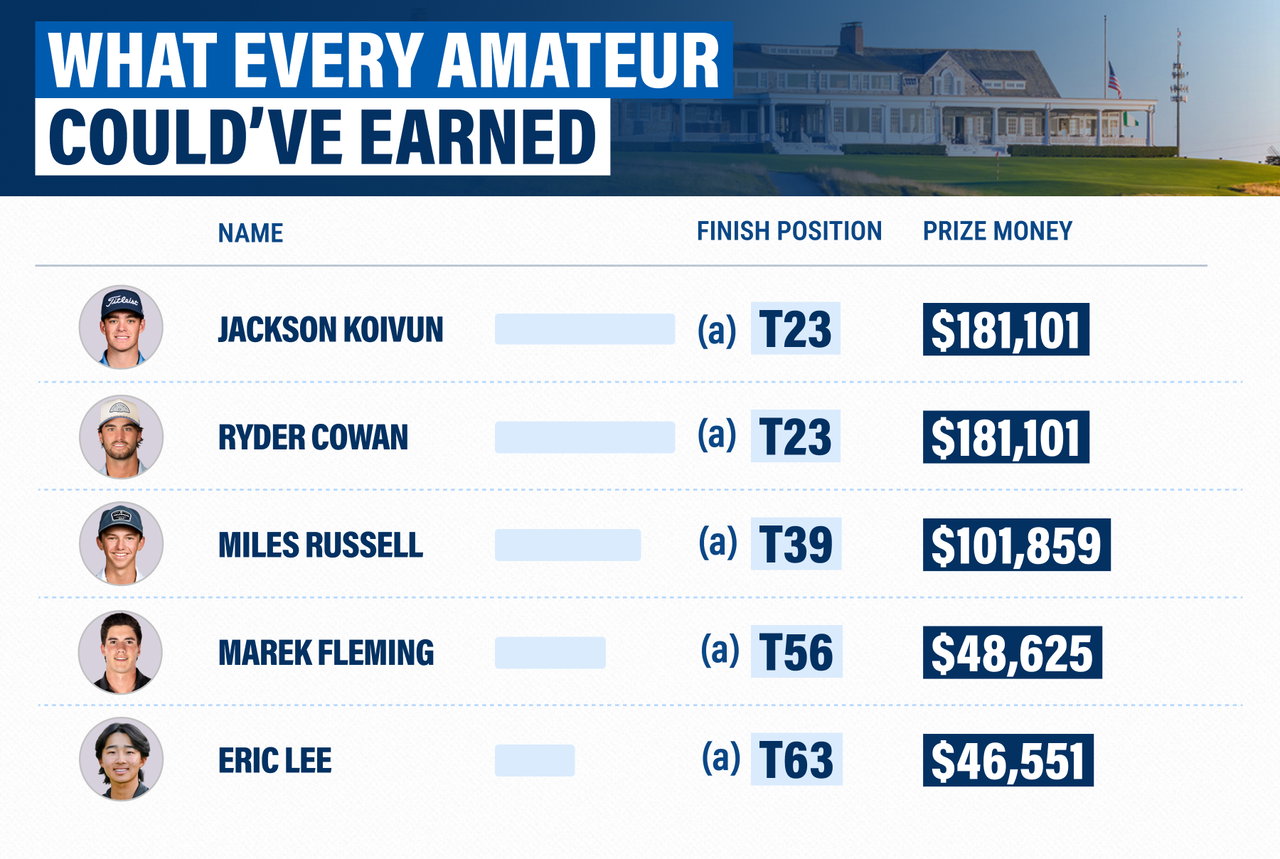
Now, 99 years later, at the 2026 U.S. Open, we have another example. There were originally 20 amateurs in the field, with Jackson Koivun (+5) and Ryder Cowan (+5) finishing ahead of them all at T23. Three other players made the cut, too, including Miles Russell (T39), Marek Fleming (T56), and Eric Lee (T63).
Here’s roughly what their U.S. Open paychecks should have looked like, as per this season’s prize money:
Shinn
Imago
Shinnecock Hills Image Courtesy: Imagn
Instead, all of them took home zero, because that’s the rule.
Rule 3.1 in the Rules of Amateur Status states that “an amateur golfer cannot play for money in a golf match, exhibition, or other competition such as a tournament. The USGA enforces the rule to maintain a clear distinction between amateur golfers and professionals.” The rule also states that “an amateur playing in a scratch competition is allowed to accept any prize, including prize money, up to a limit of £700 or $1,000 in value, per competition, unless the national governing body has set a lower limit.”
Can the money be increased? Craig Winter, senior director of rules and amateur status, said, as per Golf Digest, “Removing limits around cash prizes could overwhelm our system of handicapping, equipment, and rules, which all work together.” So, there’s your answer.
It is only fair, they claim. Still, in 2019, the USGA tweaked this rule a little after updating Rule 3-2b, giving amateurs a fair chance to earn money if they made a hole-in-one. That means amateur Vaughn Harber (MC) could have won some money had he made that hole-in-one on the 17th on Friday at the U.S. Open. But otherwise, there are really no loopholes here.
You cannot turn a pro mid-event, even if you win. Think about Nick Dunlap, the American Express 2024 winner, who did not win any prize money. Dunlap eventually turned pro following the win, thus forfeiting his remaining semesters and change of college eligibility.
Although the popular narrative says it is only fair that this happens, the amateurs themselves consider it unfair. Dunlap stated ahead of the 2024 U.S. Open, “It does kind of su-k that you can’t make any money, so you’re kind of out of [pocket] whether it’s five, 10, 15, 20 grand, whatever it is. Some kind of help at the end of the week would be nice.”
Amateurs don’t get the USGA’s $10,000 travel/expense payment for a major week, and they also miss out on the $10,000 that pros who miss the cut receive. But there is some welcome relief, like NIL. After the USGA’s approval, the college and amateur golfers can sign contracts to promote brands, make appearances, and use their likeness without losing their amateur status.
But for the most part, the situation remains problematic, and we don’t always have to rely on official statements to make an argument on that. Consider what a PGA Tour golfer spends in an average week of play.
In a TikTok video in 2023, Ben Griffin revealed he spends $6,000 minimum per week, with high-end locations like Pebble Beach costing much more. The stress and burnout once forced him to quit golf and become a loan officer. He stated, “I’d lost my motivation and love for golf. The stress of playing with $15,000 of credit-card debt was agony, so I quit.” In a Golf Digest interview, he stated a bigger number ($50,000). Several pros have often talked about it, too.

Imago
March 13, 2025: Nick Dunlap hits his approach shot on the 1st hole during the first round of THE PLAYERS Championship at TPC Sawgrass in Ponte Vedra, FL. /CSM Ponte Vedra United States of America – ZUMAc04_ 20250313_zma_c04_380 Copyright: xGrayxSiegelx
We suspect the USGA does not want the young players to turn away from golf because of that.
That is why this is a conversation worth having. Right now, many young amateur golfers should be able to handle hefty travel, lodging, and caddie bills (10% of prize money on the PGA Tour) just to experience big tournaments and find exposure. A modest stipend for those who make the cut would cover those basics and keep promising players from choosing finance over fair play. For many, a single trip across the country can wipe out a season’s savings; a guaranteed payment removes that barrier and keeps the pathway open to merit, not money.
And the governing bodies can consider that. Back in 2022, the Indian Golf Union (IGU) began offering amateurs $1,000 for every tournament they entered. The move aimed to stem the tide of amateurs turning pro prematurely because of the lure of big payouts and the steep costs of competing.
The USGA rules, on the other hand, allow an amateur to accept support from others for a single competition when expenses are $300 or less, and they state amateurs may receive financial assistance or donated equipment from outside sources to defray competition and travel costs. But that is hardly enough.
In the words of Dunlap, “I think there should be maybe some kind of end-of-the-week [stipend] to help out with some of the expenses maybe.”
So, the USGA can think of it as a small investment in the game’s future: fewer promising players dropping out for financial reasons. Essentially, though, it’s a pragmatic compromise. It honors the romantic ideal of playing for love, while treating competitors fairly in an era when travel and exposure, in the words of the players themselves, aren’t cheap.