His career has largely been defined by his two Super Bowl wins with a team known for winning clutch snow games in the Northeast, the New England Patriots.
But former NFL linebacker Tully Banta-Cain is a born-and-bred California son. He grew up and played high school football in Fremont and played college ball 40 minutes north on I-880 at University of California in Berkeley.
“I grew up around the water, around the beach with constant sun and gorgeous temps,” said the man known as TBC. “I loved the grit of the winter during my playing days and knowing I could overcome anything Mother Nature threw at me. But in my heart and soul, I am most at peace by the beach.”
He bought a house near Manhattan Beach where he gravitated to after his playing days. It’s the spot where he first conceived of marrying his two loves into a new sport: the Beach Football League.
The idea has grown into a coast-to-coast movement, first tested on the East Coast at New Hampshire’s iconic Hampton Beach with the help of his Patriots family. The 2024 game and event proved to be a huge success – combining the excitement of events like beach volleyball while giving still-fit NFL and college football players an outlet to continue to compete in the sport they have mastered.
After playing more than 20 games worldwide over the last two years, the BFL is launching a nationwide circuit in 2026, with a kickoff event in Santa Monica, Calif. on March 7.
Banta-Cain sat down with us recently to discuss his past, present and future in football – covering his biggest moments in college and the NFL, the exciting growth of the BFL and a huge year ahead for what TBC hopes syncs perfectly with the growth of flag football worldwide to someday make beach football into an Olympic sport.
So Tully, you have an exciting weekend coming up as founder of the BFL.
Absolutely, we have our first live stream event this Saturday, March 7th, in Santa Monica, California.
View this post on Instagram
What is the event out in Santa Monica? Who’s playing who?
So, it’s actually the two teams that we have slated for that game are a team that we are introducing as the first franchise of the Beach Football League, which is the Santa Monica Waves, which will comprise of former NFL players, by the likes of Dexter McCluster, Tommy Harris and DeShaun Foster will be head coaching that team with a bunch of other NFL guys that that are becoming involved as well.
Some former D1 athletes, some former rugby players, professional rugby guys, so it’s a good mix of athletes that still got some juice in the tank. They’ll be playing against the A7FL’s Silver State Stealth, which is a team out of Las Vegas that plays in the A7FL Las Vegas division, where they play full tackle, no pads on grass.
In the BFL, we play full tackle, no pads on sand. We also have a flag division and a youth division and other competitions that we do around the BFL,like one-on-one drills and Oklahoma drills. Even the Run It League out of Australia did an event with us, so we partner with other competitive leagues.
But this is an idea to showcase the Beach Football League, playing our full-tackle adult men’s game versus an existing pro league that plays full tackle as well.
Is it basically regular football on sand? Are there any rule differences?
We play 8-on-8, three-man line. So very similar to arena football, where you see a three-man O-line and a three-man D-line, but we play everyone’s eligible. So even the lineman can turn around and catch the ball.
We play on a 50-yard field, not a 100-yard field, 30 yards wide. We don’t play with field goals; we play with throw goals. So there’s essentially soccer nets on the back of of each end zone like a field goal, but instead of a kicker kicking it through the uprights, the quarterback is throwing it into the net, which is protected by a goalie, i.e. a Devin Hester or a McCluster, your punt returner. If he catches the ball and protects it from going in the net, he can return it for a live kickoff or throw off return.
OK, so there’s some real tangible differences here.
If you get a penalty on the play, you’re down a man – like hockey. So that if you jump offside or you get a pass interference, that player is out for one play. So there are different rules like that that we have to kind of set us apart, but keep the game in the same vein of the game we grew up with.
View this post on Instagram
What inspired you to create this?
It’s something that came from just playing the game. I’ve been playing football since I was eight years old. I grew up watching football in my house in the ‘80s, watching the 49ers, the Cowboys, the Raiders, all the teams of the ’80s and ’90s. What a time to watch football. So, I’ve always been a student and lover of the game. Just the excitement around it and the physicality and the camaraderie, all the things that football are, the life lessons that it teaches you.
Getting a full ride scholarship to UC Berkeley and then getting drafted to the New England Patriots, winning a couple Super Bowls, football has done a lot of good for me and my family, and so to be able to pay the game forward, I really didn’t know how.
When I first retired, I was coaching, doing commentary stuff, just trying to stay involved with the game in any way I could outside of playing the game. It wasn’t until really 10 years after I was done playing that I was just jogging the beach and I was living in Manhattan Beach at the time and I was like, there should be a beach football league.
So I Googled to see if it had been done before and lo and behold, there’s only been like some charity games. The NFL used to actually have the Pro Bowl game where they would have the rookies of that year play in a beach flag football game until Robert Edwards blew his knee out unfortunately and they discontinued having that.
So, that was kind of where I saw an opportunity, and then COVID hit. I was like, Oh, well, it’s out the window. No more going outside, especially to the beach to play football. It was really the inspiration, also drawn from going to AVP volleyball games on the beach, where I would see these stadium setups where they would put activation tents and you see all these celebrities and athletes coming to the beach to watch a volleyball game.
And I thought, well, if they love volleyball, then they would definitely love football on the beach. Part of the inspiration too is watching how that league and like P1440 and some of the other volleyball leagues have been able to create a fan base and a viewer base for beach volleyball and see that become an Olympic sport.
So, fast forward to 2021, the COVID pandemic is over for the most part and I get an internship with the 49ers. I was in the back of the meeting room and Nick Bosa is over to my left and Eric Armstead to my right, coach Kris Kocurek is right there, you know, coaching the guys up and I’m like, man, I’m not playing. I can’t even coach really because I’m an intern. I just got to sit and watch.
So, I’m back there drawing up beach football rules, drawing up the logo, drawing up the idea of beach football. In the event that this job doesn’t stick, I’m going to go ahead and start my own league.
And I didn’t get the coaching job. So, the rest is history.
What was the 49ers internship all about? And what did Bosa and Armstead and those guys think of the idea when you broached it?
It’s funny because it wasn’t something that I was like telling guys, “Hey, I’m starting a beach football league” in the back of the meeting, because I didn’t want to set a bad precedent that I wasn’t there to learn from the coaching ladder for the right reasons.
As a coaching intern, you’re at the bottom of the ladder for coaching. It’s a lot of just watching and observing, taking notes. Of course, you’re talking to players, you’re getting to know some players, but it’s not the atmosphere to pitch ideas really. I just didn’t want to make it about the Beach Football League, especially how young it was.
Now I’ve had a chance to run into Armstead at the Super Bowl and I told him that we’re doing a beach football event in Jacksonville, which he said he would come through for.
Fred Taylor, who I played with, was another Jacksonville guy. And even in Nick Bosa, if I see any of these guys now and they did give me that opportunity to meet them ahead of schedule and be able to invite them to come out to just watch or if they want to get involved as an owner or a player ambassador, that’s on the table.
There are so many different moving parts when you start a league you know there’s so much that I didn’t realize. The mountain was so tall to climb and putting together all of the logistics around it, and you know this is in 2021.
We didn’t really officially launch the league with an event until 2024. So that just shows you the time that it took to kind of put all the pieces together, getting players to commit, getting coaches to commit, getting beaches and city councils to approve a beach football event.
All the things that it takes to put a league together, I didn’t know at that time, but now we’re in a better space and the league is starting to grow some legs. So, it’s been exciting to say the least. Now in the offseason, we’re looking to get some of these Nick Bosa or Eric Armstead types to show up.
What has been the biggest challenge for you in getting this to the point of a sustainable pro circuit?
A lot of it has been about identifying what the league is and getting people to understand what it is or what it can be, because with the growth of flag football, many people assume it’s a flag football league on the beach. So that was a perception around the league that I want people to understand that we are everything beach football.
We are tackle, we are flag, we are youth, we are adult, we are men, we are women, we are boys and girls, we cover all of the spectrum of football on the beach. We even have one-on-one competitions and all the other stuff that we can partner in to make it a special event.
That’s really the biggest thing, was figuring out what the league is and how to introduce it in a way that is palatable for people to enjoy, because people enjoy the beach and people enjoy football, but there are certain elements that we know are more interesting than others. Personally I love playing flag football but I don’t like watching it.
NFL players lose a little bit of their relevance when they’re no longer in the league. And there are guys that are still looking to play. There are still guys who will go and do an MMA fight. There are guys who will go play in the XFL, the CFL, or the AFL.
And there are opportunities for guys to stay active as a player, coach, commentator and more. So I wanted to lead with was it being a pro-level, familiar-named league where you got guys like Terrell Owens or a Devin McCourty or a Tom Brady playing in the Beach Football League so that it would be taken seriously as you know a premier league that people would want to come out and watch these former guys play at a high level.
I realized soon that it’s not easy to get guys to commit to playing tackle football with no pads on the beach post-retirement. There are a lot of players that are down to do it, as we’ve been able to showcase, but I would say that the toughest thing is getting guys to really buy into it.
And once they do and they see the potential that it has, once they see that there’s an opportunity to play football year round and to play in another atmosphere that hasn’t really been explored to the level that we’re doing it, the light bulb goes on.
So, partnering with the A7FL, they’ve been around 11 seasons. They have 30-plus teams. And these are all guys that either played high school, college, maybe had a cup of coffee in the NFL. But they love the game enough that they’ll still go out and play with no pads, full tackle, like I used to do when I was a kid, when I would just go out to the park and play with my buddies. We wouldn’t play with pads.
You know, flag wasn’t really a thing back in those times. So the idea was that we wanted to introduce it as a tackle football league but with all the growth of flag, we didn’t want to ignore that and also the safety measures around flag football are taken seriously on our end as well. So we already look at playing on the sand as a safer alternative in general.
There’s a playground study on the safest surface for a kid to fall on from, say, the monkey bars and it’s sand – not grass, not tan bark, not rubber, not turf. Sand is the safest surface and that’s something that I think we really take as an advantage in playing in the BFL.
A lot of the NFL and college and high school concussions do come from the head hitting the ground, not so much the collision above the ground. So there’s more data that will have to be researched for us, but that was another hurdle was … what about the injuries? What about Robert Edwards? What about the concussions?
So to be able to offer football, not just tackle, but flag, and then show that it’s safer by playing on sand, it slows the game down slightly. The sand is a safety net for players falling down or hitting their head and there’s more forgiveness in terms of your foot not getting stuck and where on other surfaces, you get that ACL or you get that bad knee bend, you just really slide on sand.
So, not to say that you can’t get injured on sand, but the probability is lower and in all of the 20-plus games that we’ve had so far, there has not been one knee injury or head injury. Couple guys have gotten a hammy tightening up or a groin getting tight, but there hasn’t been anything that’s caused for an ambulance.
But, that’s one of the things that we want to really show is that this is a safe alternative for players. This is a fun alternative for players. And it’s really a chance to continue your career in a place that hasn’t really been showcased, but I know 90 percent of people on the planet love the beach.
You’ve got it going coast to coast with your 2026 schedule, and it marries your life in California and your upbringing with your pro-life, which much of it happened on the East Coast in New England.
You actually teamed with the Patriots on one of the first events up at Hampton Beach in New Hampshire, right?
View this post on Instagram
That was a strategic play on my end. Understanding that I did play for the Patriots, and if I’m going to launch a league and get people to support me. I have gotten a lot of support from my California fans. But I knew that I had a bigger football fan base in New England, and that if I did an event in New England, I could get support from the Patriots. I could get some local players who live in the area to come out and be ambassadors for the event.
Hampton Beach is a great starting point for us because they have a great backdrop. There’s a lot of activity already on the boardwalk.
And they love the Patriots out there. So to be able to bring out some local media people, you know, players that lived in the area, former and current, we had guys like Jaime Collins and Kendrick Bourne come out.
To be able to get guys like that to come out for our first event, that really gave us a bigger impact to introduce it to places like California, Jersey, Florida, where now we’re approved because of that first event in Hampton that got a great response from the people that attended, played.
So we were able to come back just this past year to do it again. So we’re essentially building it off that event. We did an event in Hermosa Beach a long time ago just to see what it looked like.
But to be able to see it fully brought to life with people watching from all over the sidelines, to having the vendor villages, to bringing out Mikey V from Kiss 108, to having all the celebrities that came out, the sponsors that we’ve been able to pull. It’s just been great to see it come to life.
View this post on Instagram
You also had a great reception at the Super Bowl this year.
Yeah, every year I try to go and get as much networking done as possible. This past one was no different. Being in my hometown in Santa Clara, having played for the 49ers, it was only right to come back, and the Patriots were playing in the Super Bowl. It was like the biggest homecoming for me. They didn’t win the game, but the networking abilities that I got to go through, all the preliminary events, and mix with people.
That was what you see on some of my social media posts. Talking to a T.O. [Terrell Owens], a Tom Brady, or a Rampage Jackson, telling them about the BFL. Having them say, “Hey, I’ll see you on the beach,” that lets me know that it’s not a hard sell.
You get people to come to the beach to watch football or to play football. So, the Super Bowl being in LA next year, the goal is to have a BFL event during Super Bowl Week, and really get the names involved and build it into, hopefully, a staple that kicks off or ends the NFL season and kicks off our spring-summer tour.
You’re a beach guy. You’re a California guy. You went to UC Berkeley. What was it like playing for the Patriots in mostly winter weather?
I was just talking about that with someone else. I mean, the acclimation was crazy. I had been to the East Coast once in my young adult life — when we played against Rutgers my junior year at UC Berkeley. Other than that, I’ve been to North Carolina. I have a lot of family [there], which is considered the Southeast. So, it does snow there, but I was never there long enough to really experience it.
So yeah, it was a huge shock to have to practice in the snow in the 20-degree weather. I was a guy who definitely played special teams early in my career. I was thankful that I wasn’t a guy sitting on the bench just waiting to go in on defense and that I could run down the field on a kickoff or a punt just to stay warm, and be involved in the defense, too.
Because that’s the one thing about playing in the cold — if you’re not moving or you’re not drinking up in the stands, it’s brutal.
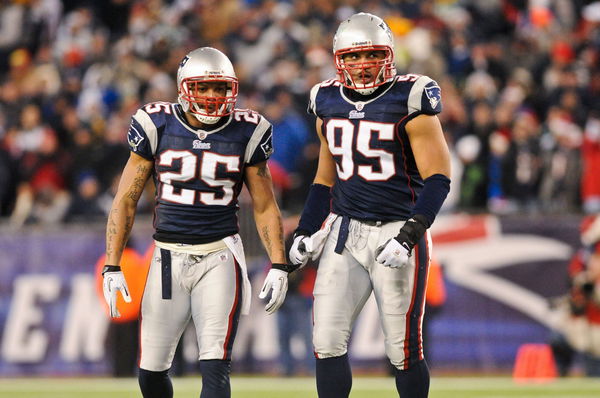
Imago
Dec. 19, 2010 – Foxborough, Massachusetts, United States of America – New England Patriots S Patrick Chung (25) and LB Tully Banta-Cain (95) walk off the field after the play. The New England Patriots defeat the Green Bay Packers 31 – 27 at Gillette Stadium. – ZUMAq39
You came into a thoroughly veteran group in the linebacker room with the Pats. So special teams was where you had to break it in, right?
Yes, that’s what they tell you if you’re not starting on defense. You need to be starting on special teams, or you’re not on the team. I learned that early.
Coming into that linebacker meeting room, and I’m the only rookie in there. It’s Tedy Bruschi, Willie McGinest, Mike Vrabel, and Roman Phifer. Everyone was like an eight-, nine-, 10-year vet, and here I am. This snotty-nose rookie is coming in out of California.
I had to grow up fast. I had big shoes to fill, and Belichick was like the linebacker coach and pretty much the defensive coordinator as well as the head coach. The pressure in those meeting rooms and those practices was pretty high. I was a seventh-round pick, so there was a lot of proving grounds for me.
But you see that with Brady, the sixth round [picks], the Julian Edelmans, some of the other guys that were in that locker room or in that facility. Everyone was earning it, even the interns.
Matt Patricia, Scott Pioli, Eric Mangini, Romeo Crennel, even Phifer was a player-coach. Vrabel was definitely a player-coach. Pepper Johnson was a coach. So just to see where everyone went from there, right up the line to today with Brian Flores.
I played with [Kevin] O’Connell, the head coach with the Vikings now. These are guys that were my teammates, now they’re head coaches. These are guys who were interns. Now they’re head coaches or defensive coordinators. Patrick Graham, right? So, there are so many guys who came through that facility, that organization who have gone on to do great things.
It was just a serendipitous opportunity for me to come from. Beautiful warm weather, fair weather California, to a cold-weather championship city like Boston, where I’m watching the Red Sox win the World Series and the Celtics win and the Bruins and then being on the Patriots in the span from 2000 to 2020 … man, itwas just like the golden years of what it was like growing up in the Bay Area, and watching the 49ers win it every year or watching the the Oakland A’s or the San Francisco Giants.
There’s a big sports culture here in the Bay Area. Seeing that over in Boston and then living it and playing in it, what a blessing.
To see how the culture of winning is built, that had to be an incredible learning experience for you as a budding entrepreneur.
Oh, big time. I draw on a lot of my football experience to translate into the business world. Just the collective effort that it takes, and the mindset that it takes collectively to be successful in something.
There is a difference in why you win and lose, and there are glaring things that you can point out about why you lost, and there are glaring things about why you win.
It comes down to the mindset and the collective effort, that’s what I’m building with the Beach Football League. I’m building this thing with the same mentality: bringing in the right people who want to see it win, believe in it winning, and are willing to do the job to get it done. That’s everything in life.
So we’re going all in on a dream here, and if anything doesn’t work, we keep tweaking the fixable parts. This is a baby that we’re raising with the BFL, and it’s got a lot of potential, but it’s going to take a lot of collective effort from people who believe in it.
Because it’s bigger than me. You know, it’s an idea that I had that, you know, beach football is almost crazy that there hasn’t been an organized league in the past. I know there’s been rec leagues and stuff like that, but to make it a professional sport, just like flag is becoming one. It’s only right that, you know, more people get involved. And my inevitability is that the NFL and some of the bigger partnerships that could align will happen because, you know, it has the potential for that. And once it gets to that point, there will definitely be a village and cohesive team that is running the show.
Watch the full interview below.