
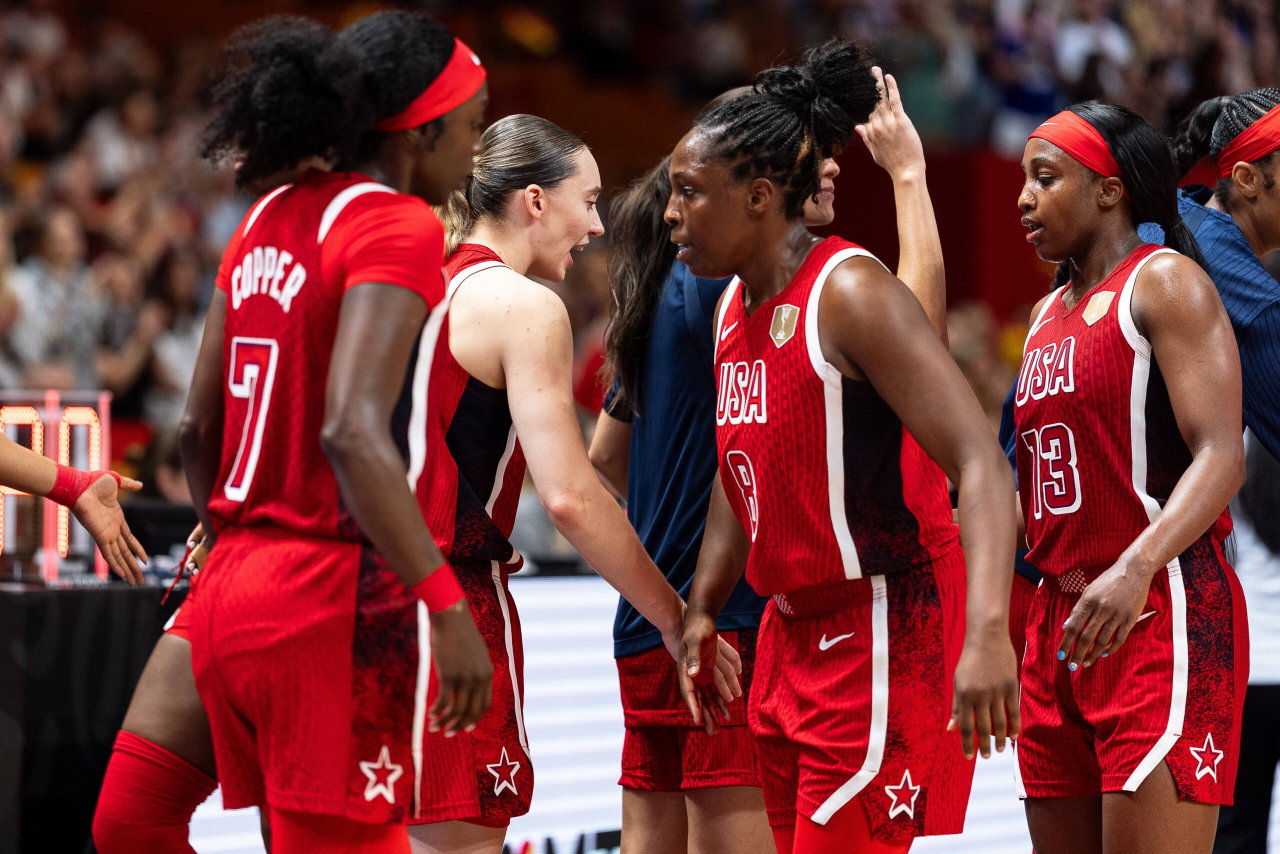
One of the most persistent criticisms leveled at coach Kara Lawson throughout Team USA’s gold medal run was her decision to build around the team’s veteran core, starting the same five experienced players in every single game while the younger contingent of the roster waited on the bench. Former ESPN host Linda Cohn was among the most vocal critics of that approach, particularly when it came to Caitlin Clark not earning a starting spot and not receiving as many minutes as many felt she deserved.
Watch What’s Trending Now!
“I wanted to see Caitlin Clark and Paige Bueckers out there at the same time,” Cohn said in a video shared on her YouTube channel on Monday.
“Yes, a win for Kara Lawson, a win for that coaching staff. But I still think they should have played more. I mean, they had the best bench in this tournament. And most of this tournament, the bench, the way they played, to me, was better than the veterans played. They were more consistent.”
The story that eventually played out was that Team USA won, and those same veterans were central to making it happen, delivering when it mattered most in the championship game against France. But even with the gold medal secured and the result apparently vindicating Lawson’s choices, Cohn is still not backing down.
The numbers around the minutes distribution do support Cohn’s observation about how lopsided the playing time was. Breanna Stewart and Jackie Young logged 30 minutes apiece in the final. By contrast, Caitlin Clark played 13 minutes, Angel Reese nine, Paige Bueckers three, and Aliyah Boston 16. The same five veterans, Stewart, Young, Chelsea Gray, Kahleah Copper, and Napheesa Collier, started every game and averaged the most minutes across the entire tournament.
However, the veterans justified Lawson’s faith, especially in the final when France was at their most threatening in the first half. Stewart delivered a game-high 22 points alongside 10 rebounds and four assists. Young contributed 18 points, six rebounds, and five assists. Copper added 15 points, Gray finished with 12 points and five assists, and Collier rounded out the starting group with six points, seven rebounds, and one assist. In the biggest game of the tournament, the experienced core was exactly what Lawson had bet on them being.
Of course, there were games where not all the veterans turned up, especially in their narrow 55-52 win against Italy and their gritty 76-66 victory over Spain. However, those games were not exactly clear examples of outstanding displays from the young and talented players either. In those games, the whole team appeared to struggle, save for a couple of standout performances, like Jackie Young and Angel Reese against Italy and Young, Stewart, Copper, and Boston against Spain.
So, the pattern that appears to be apparent is that, in those tough moments against strong opposition, Lawson consistently leaned on her experienced players. That was most visible in the final against France, where at least four veterans were on the floor simultaneously during the first half, when France was shooting 8-of-14 from three and pushing Team USA to within two points at halftime.
Of course, the younger group did inject energy and impact in key moments, most notably in the third and fourth quarters of the final, when Team USA pulled clear after the Caitlin Clark buzzer-beater three-pointer sparked the momentum shift. But the feeling throughout the tournament was that Lawson was comfortable deploying the bench mob only once the veterans had established sufficient comfort and control.
Whether Lawson should have trusted the younger players with a greater share of the responsibility, and whether that would have produced a smoother, more dominant run or exposed the team to unnecessary risk, is a question nobody can answer with certainty now that the trophy is already won.
What can be said, however, is that the veteran core delivered when it mattered most, and the result speaks for itself. Whether that makes Lawson’s approach the right one, or simply the one that happened to work, is a conversation that can continue as long as it can.